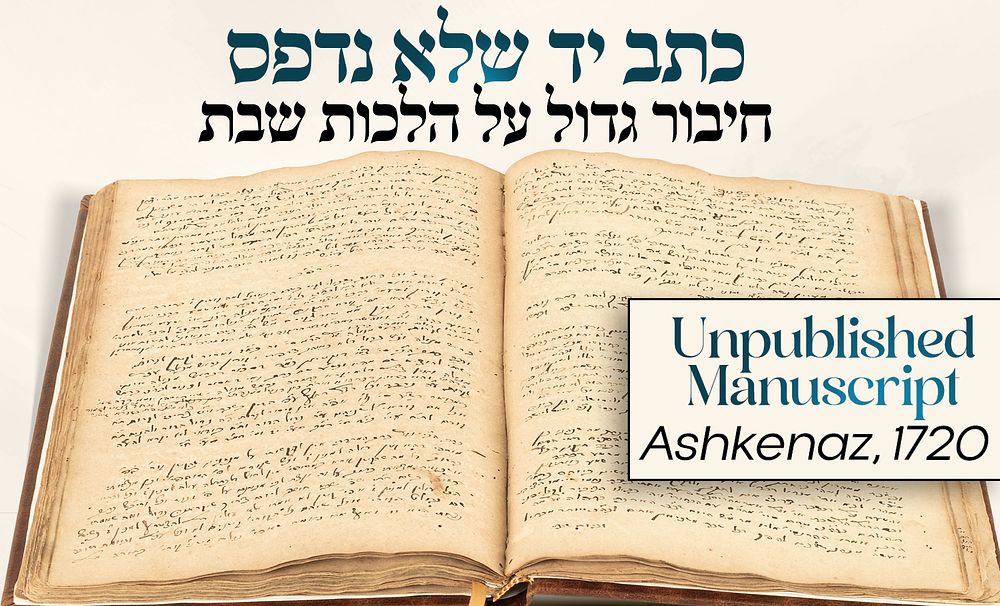
Bidspirit auction | Unpublished Manuscript – Major Halachic
Unpublished Manuscript – Major Halachic Work on the Laws of Shabbos – Ashkenaz, circa 1720 * A manuscript comprising 180 large pages in the handwriting of an unidentified gaon, one of the sages of Ashkenaz in the early 18th century, and a disciple of Rabbi Ziskind Rotenberg, Av Beis Din of Witzenhausen, Posen, Lublin, and Brisk. The entire work is devoted to the laws of Shabbos, arranged according to the order of the simanim in the Beis Yosef, from siman 242 through siman 344. The body of the composition contains chiddushim and in-depth analyses of the words of the Rishonim and Achronim, along with a defense of the rulings of the Beis Yosef and the Rema against the challenges raised by the Taz and the Magen Avraham. The author also cites the Zohar on several occasions. At the end of the work, the author appended a special kuntres titled “Klalim, ” spanning twenty pages, in which he brings concise halachic rulings, with references directing the reader to fuller discussions within the main text. The author clearly intended to publish the work, as he notes on the first page, and he also writes that he showed his writings to wise scholars, who praised them. The buyer of this manuscript will thus be allowed to fulfill the author’s unrealized aspiration and publish his chiddushim, thereby allowing his words to live on. The author refers with the title “Mori VeRabbi” to the gaon Rabbi Mordechai Ziskind Rotenberg, one of the leading sages of Ashkenaz of his generation and a relative by marriage of the Chavos Yair, who was among those who endorsed the Magen Avraham (leaf 11a). He also writes, on several occasions, teachings he heard from Rabbi Yosef HaKohen, Av Beis Din of Hanover, who passed away in 1704. Although the author does not explicitly state that he served in a rabbinic capacity, his tone in certain passages strongly suggests practical halachic authority. For example, he writes: “Now the words of the Rema are vindicated… and all the doubts raised by the Taz and the Magen Avraham are resolved — as stated above, both in theory and in practice, if the great halachic authorities concur with me.” The manuscript was written over many years. It appears that the bulk was composed around 1720, based on the sefarim cited, most of which had been printed by that year — for example, Shevus Yaakov II (1719), Kol HaRemez (1719), and a reference to the Chacham Tzvi, mentioned with a blessing for the deceased (d. 1718), and others. On leaf 9b, the author refers to a “recently printed” work — Lechem Shamayim of the Yaabetz, printed in 1733. On leaf 11a, he cites responsa of his teacher Maharam Ziskind (printed 1716). In siman 295, the author wrote a passage concerning Eliyahu HaNavi on Motzaei Shabbos, which he later crossed out with a line. Regarding this section, he writes in the Klalim section: “I instruct my sons and those who heed me to study this siman… and it shall bring them success and prosperity, and they shall merit the coming of Eliyahu, of blessed memory, together with Mashiach ben Dovid, speedily in our days.” Structure of the Work: In the first eight pages, the text of the Beis Yosef and the Rema is copied in one column, with the author’s work alongside it in a second column. From that point onward, only the present composition appears, written in a single wide column. Ashkenaz, circa 1720 and the years close to it. Written in the author’s handwriting, with glosses, additions, and deletions. Page Count: [92] leaves, comprising approximately [180] written pages. The main body of the work is complete; it appears that one or two leaves may be missing at the end of the Klalim section. Size: 31.3 cm. Condition: Fair to good; holes and repairs, mainly in the first and last leaves. Fine new leather binding. The manuscript is legible and ready for print. - - - - - - - - - - - - - - - The Author’s Halachic Chiddushim in the Present Work · The third Shabbos meal should be eaten before plag minchah, and one who eats it afterward does not fulfill the obligation of eating the third meal. · He writes sharply that one must wash hands before Kiddush (in accordance with the Rema), not afterward. · He writes that one who does not require immersion for purposes of purity should not immerse on Shabbos morning. · Regarding the nusach of the Shabbos prayers — “וישמחו בה/בו/בם… שבת/שבתות קודשך” — he comments: “I recall from my youth that this was not recited in the great holy communities; rather, ‘וישמחו בך ישראל מקדשי שמיך.’” (See at length Shorshei Minhagei Ashkenaz, vol. I, p. 59 onward, where it is identified as the custom of Frankfurt am Main.)