Bidspirit auction | Dozens of Unpublished Glosses in
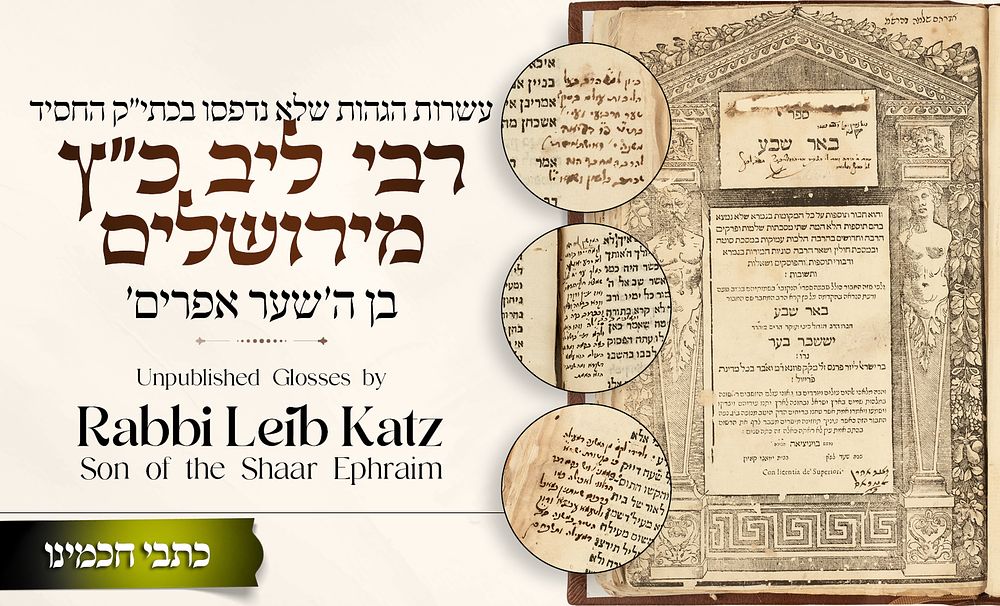
Dozens of Unpublished Glosses in the Handwriting of Rabbi Leib HaKohen Katz of Jerusalem, Son of the Shaar Ephraim – on Sefer Be’er Sheva. Venice, 1614 * Be’er Sheva, a sefer yesod, is a commentary on masechtos and sections of the Gemara that do not have Tosfos, such as Horiyos, Tamid, Kerisos, and others. Condition: Fair–poor. It was written by the gaon Rabbi Yissachar Ber of Eilenburg and Tzfat, one of the great Achronim of the generation following the Rema and the Maharshal. This is an exceptionally important sefer. The Maharal of Prague testified in his approbation at the beginning of the sefer that the chiddushim were written: “With astonishing breadth and sharpness… they are worthy to be studied and taught in yeshivos throughout all of Klal Yisrael.” This copy belonged to the gaon Rabbi Leib Katz of Jerusalem, son of the renowned posek, the Shaar Ephraim, Rabbi Ephraim HaKohen of Vilna. Rabbi Leib was the one who edited and printed the sefer Shaar Ephraim, adding his own fundamental glosses, which are cited by later poskim. Rabbi Leib was the uncle and friend of the Chacham Tzvi, and together they learned much Torah and wisdom from the Shaar Ephraim (as Rabbi Leib himself testifies in his introduction). The Yaabetz refers to him in his sefer Megillas Sefer as: “The distinguished rav, Moreinu HaRav Yehuda Leib, z”l…” His holy signature appears at the head of the title page: “Me’es Hashem haysa zos li hatza’ir Aryeh Yehudah Leib…” Throughout the sefer there are approximately forty brilliant glosses and various notes in his handwriting. The Chida praises him greatly and wrote in Shem HaGedolim: “And I have seen his manuscript glosses.” In one gloss, he cites his illustrious father: “What I heard from my father, my teacher, the gaon zt”l” (68a). Elsewhere he references the sefer Shaar Ephraim of his father, which he himself published (46a). On leaf 50b, the author printed that a certain text requires correction, considering it an error. Rabbi Leib writes that in his opinion, no emendation is necessary, explaining why, and “not as the author understood, together with several great authorities, for the Torah lies open to all, and Hashem will enlighten our eyes in His holy Torah… and I, like a dwarf among giants – it appears to me as I wrote above that no emendation is required.” The glosses on maseches Kerisos (six glosses) were published in Tzefunos IV from this very copy, and later reprinted in newer editions of the sefer by Machon Zichron Aharon. Part of another gloss from leaf 55b was published in Beis Aryeh Leib, Jerusalem 1994, p. 9. To the best of Zaidy’s knowledge, the remaining glosses have never been publicized! The eminent gaon and chassid Rabbi Leib HaKohen Katz (after 1648–before 1732) was the youngest son of the renowned posek Rabbi Ephraim HaKohen of Vilna. He studied under his illustrious father with his nephew, Rabbi Tzvi Ashkenazi, the Chacham Tzvi (who was Rabbi Ephraim’s grandson). In 1686, he immigrated to Jerusalem and remained there for one year, during which time he prepared the sefer Shaar Ephraim for print. He later returned to Europe and printed the sefer in Sulzbach in 1688, adding an extensive and interesting introduction as well as numerous glosses that are cited by the poskim. Afterward, he returned again to Jerusalem, becoming one of the leaders of the Ashkenazic community there, and he was the one who proposed appointing Rabbi Dovid Oppenheim of Nikolsburg and Prague as “Nasi of Eretz Yisrael.” He was a signatory to the Jerusalem ban against the Sabbatean sects, together with his mechutan, Rabbi Avraham Yitzchaki, the Chief Rabbi of Jerusalem. His step-grandson was the famed gaon Rabbi Yaakov Culi, author of Me’am Lo’ez, son of Rabbi Machir Culi, who married Rabbi Leib’s daughter in a second marriage. Rabbi Moshe Zacuto wrote of him in his approbation to Shaar Ephraim: “The strength of the son [Rabbi Leib] surpasses that of the father twofold in wisdom, for his father’s greatness rests upon him in double measure.” While in Eretz Yisrael, he adopted a Sephardic style of handwriting in addition to the Ashkenazic style — a very rare phenomenon among the sages of Ashkenaz (similar to the kabbalist Rabbi Meir Poppers and a select few). See, for example, such glosses on leaf 46a. Gloss by Rabbi Leib Glosses by Rabbi Leib on kerisos Venice, 1614. First edition. Printed during the lifetime of the author. Page Count: [18], 122 leaves. Size: 29 cm, with several shorter leaves. Condition: Fair–poor, with numerous holes throughout the volume. Crude repairs on many leaves. Please see photos prior to bidding. The sefer is being sold due to the importance of the glosses. Most are intact, legible, and suitable for publication. Provenance: Collection of Rabbi Rafael Reichman zt”l. Bibliography: Stefansky, Sifrei Yesod, no. 70.