Bidspirit auction | May One Build a Balcony
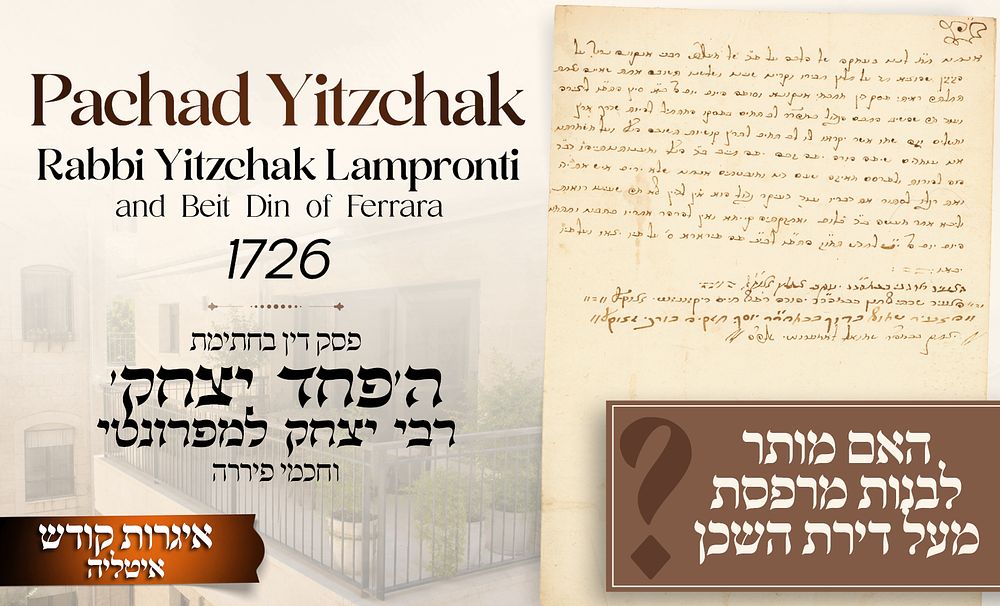
May One Build a Balcony That Darkens a Neighbor’s Home? A Highly Relevant Halachic Ruling Signed by the Pachad Yitzchak, Rabbi Yitzchak Lampronti, and the Sages of Ferrara – 1726 * A halachic ruling bearing the handwritten signature of the gaon Rabbi Yitzchak Lampronti, author of Pachad Yitzchak, together with the signatures of three sages of the Ferrara yeshiva. The ruling was issued as part of a major halachic controversy concerning a question that remains highly relevant today and continues to come before batei din: A resident of an upper floor wishes to build a balcony. The neighbor below objects, claiming that the balcony will block the sunlight and darken his home. Can the neighbor prevent the construction? This question arose in Ancona in 1726 — exactly three hundred years ago. The rabbanim of the city, led by Rabbi Shimshon Morpurgo, author of Shemesh Tzedakah, ruled that the balcony could be built, but only to a limited extent and in a manner that would not cause substantial darkening. Rabbi Yaakov Abuhav of Venice disagreed, maintaining that the lower neighbor’s right to prevent the loss of light must be protected. The dispute developed into a wide-ranging halachic debate, and the rabbanim of Ancona appealed to the leading sages of Italy for their opinions. The overwhelming majority supported the ruling of the Ancona rabbanim, among them Rabbi Yitzchak Lampronti, author of Pachad Yitzchak; Rabbi Nesanel HaLevi of Padua; Rabbi Dovid Finzi of Mantua, father-in-law of the Ramchal; Rabbi Raphael Meldola of Pisa; and many others. In the present letter, the sages of Ferrara concur with the final ruling of Rabbi Shimshon Morpurgo, declaring that a dayan can judge only according to what his own eyes perceive and that his ruling should not be questioned. This very letter was printed in 1743 in Shemesh Tzedakah by Rabbi Shimshon Morpurgo (Vol. I, Choshen Mishpat), siman 32. Simanim 13–32 are devoted entirely to this issue, with the present letter appearing as the final teshuva in the series. The letter bears the signatures of the city’s Av Beis Din together with three sages of the Ferrara yeshiva: Rabbi Yitzchak Lampronti Rabbi Mordechai son of Rabbi Yaakov Tzahalon Rabbi Shabsai Elchanan son of Rabbi Yehudah Raphael Chaim Recanati Rabbi Shmuel Baruch son of Rabbi Yosef Chizkiyah Borgi Rabbi Yitzchak Lampronti (1679–1756) was a leading Italian Rav. He became widely known throughout the Jewish world for his monumental work Pachad Yitzchak, an alphabetically arranged encyclopedic compilation of teshuvos, principles, and halachic rulings. In addition to his greatness in Torah, he disseminated Torah and had many disciples. He was also an expert physician and, in his exceptional righteousness, performed many acts of kindness, as Rabbi Chananel Nipi attested in his work Toldos Gedolei Yisrael, section Yud, entry 12. Rabbi Mordechai Tzahalon (d. 1749) was one of the Sephardic rabbanim of Ferrara — a gaon, dayan, physician, and poet. Toldos Gedolei Yisrael (p. 235) writes of him: “He dealt sternly with the wicked to uphold the laws of the faith, and all stood in awe of him. We have heard wondrous accounts of what he accomplished in this regard.” Rabbi Shabsai Elchanan Recanati (d. 1738) was one of the Sephardic rabbanim of Ferrara and one of the teachers of the Pachad Yitzchak. His teshuvos were printed in Devar Shmuel by Rabbi Shmuel Abuhav and in Shemesh Tzedakah by Rabbi Shimshon Morpurgo. Rabbi Shmuel Baruch Borgi (d. 1736) was one of the Ashkenazi rabbanim of Ferrara. He received semichah from the Ramaz and was a friend of the Pachad Yitzchak. Although the recipient is not explicitly named in the letter, it was clearly addressed to Rabbi Shimshon Morpurgo, whose ruling the signatories supported. Ferrara, 1726. Double paper leaf, written by a scribe and bearing four autograph signatures. Size: Approximately 14.5 × 20 cm. Condition: Good. Tiny raised imperfections along the left side of the leaf. A few stains. Halachic Ruling by the Sages of Ferrara, Printed in Shemesh Tzedakah, Siman 32