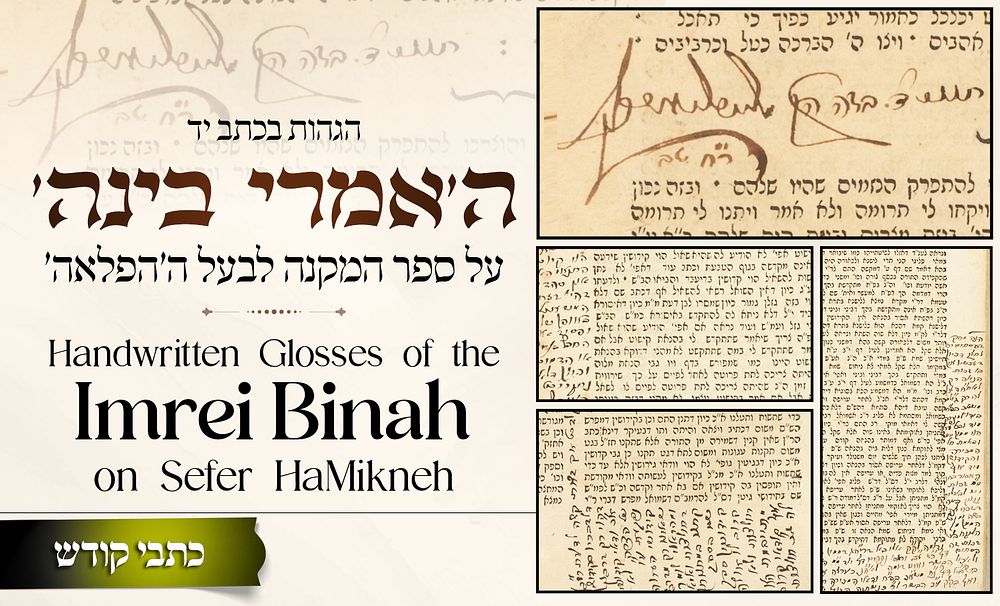
Bidspirit auction | Handwritten Glosses of the Imrei
Handwritten Glosses of the Imrei Binah on Sefer HaMikneh by the Hafla’ah. Offenbach, 1801 * A sefer yesod: Sefer HaMikneh containing chiddushim on the entire maseches Kiddushin together with a Kuntres Acharon on the halachos of kiddushin, by Rabbi Pinchas HaLevi Horowitz, Av Beis Din of Frankfurt, author of Hafla’ah. This is an extremely important sefer on this maseches, one of the most widely studied masechtos, and it is always close at hand for lomdim. At the beginning of the sefer is the signature of the Imrei Binah: “Through Hashem’s kindness to me, the humble Meir Auerbach.” The Imrei Binah learned the sefer with great iyun, and throughout the volume he wrote close to twenty glosses in his characteristic handwriting, some of them quite lengthy. A number of the glosses are trimmed at the sides, but most are complete and legible. Some of the glosses found here have parallels in Rabbi Meir’s great work, Imrei Binah. For example, the gloss on leaf 45b can be compared with Imrei Binah, Kuntres b’Dinei HaKinyanim, siman 12, se’if 2; the gloss on leaf 212b with ibid., siman 19; and the gloss on leaf 124b with ibid., siman 27. To the best of Zaidy’s knowledge, these glosses have never been publicized. The owner of the sefer, Rabbi Meir Auerbach, author of Imrei Binah (1815–1878) , studied Torah from his father Rabbi Yitzchak Auerbach, author of Divrei Chaim, and from his grandfather, author of Divrei Mishpat. He served as Rav of Kalish, and for that reason was known all his life in Yerushalayim as “the Rav from Kalish.” In 1860, he immigrated to Yerushalayim and was immediately accepted by the great rabbanim of the city as Rav and head of the Ashkenazi community. The Beis Din, which until then had been in the Churvah of Rabbi Yehudah HaChassid, was moved to the “courtyard of the Rav from Kalish.” The Maggid of Yerushalayim, Rabbi Yadler, in his book B’Tuv Yerushalayim, writes that Rabbi Meir was “one of the giants who stood on guard in Yerushalayim to ensure that all conducted themselves according to Torah and mesorah.” He further writes that in Yerushalayim, people saw tangibly that the saying, “A tzaddik decrees and Hakadosh Boruch Hu fulfills [the decree], ” was fulfilled in him. The well-known prohibition, still observed today, not to play multiple musical instruments at weddings in Yerushalayim, was instituted by the Imrei Bina. See Shu”t Salmas Chaim by Rabbi Yosef Chaim Sonnenfeld, siman 101, where he writes: “And one who disregarded it and belittled it was severely punished.” The author of the sefer, Rabbi Pinchas HaLevi Horowitz, Av Beis Din of Frankfurt am Main (1731–1805) , illuminated the eyes of Klal Yisrael with his sefarim. He spread Torah and taught disciples in both Nigleh and Nistar, foremost among them his primary disciple, the Chasam Sofer. This copy lacks the title page and is in fair to good condition, and is being sold solely on account of the importance of the glosses. Offenbach, 1801. First edition. Page Count: [4], 256 leaves. Size: 32.2 cm. Condition: Holes in some leaves. Old binding. Stamps of the Beis Medrash HaChadash in Kalish, the city where the Imrei Binah served as Rav. Bibliography: Stefansky, Sifrei Yesod, no. 98.