Bidspirit auction | Chumash in Spanish for Descendants
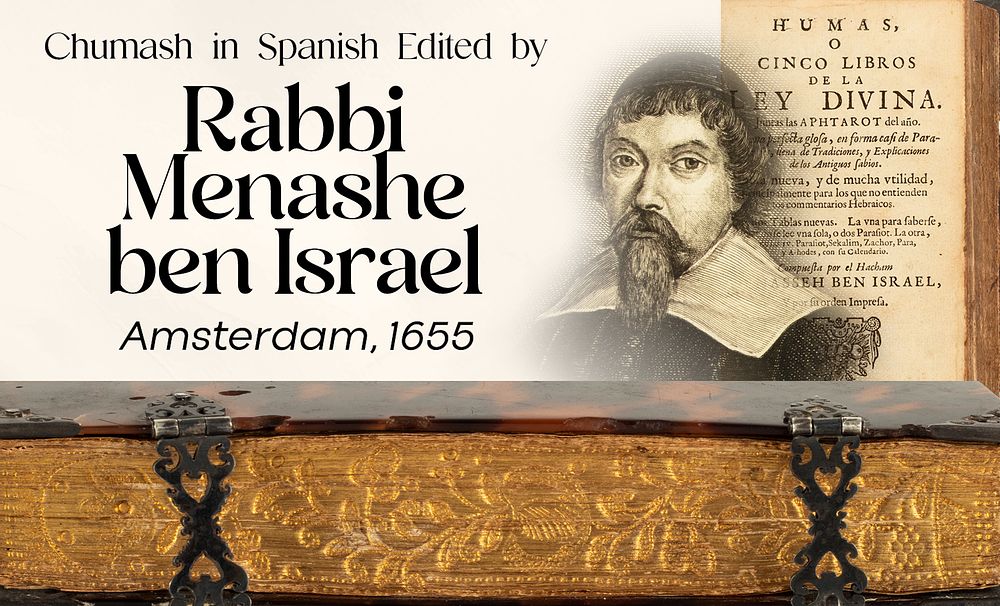
Chumash in Spanish for Descendants of Anusim, Edited by Rabbi Menashe ben Israel – First and Most Accurate Edition – Amsterdam, 1655 * A complete volume of the Chamisha Chumshei Torah, together with the haftarah readings for the entire year, printed entirely in the Spanish language. This edition was carefully prepared and corrected by the renowned scholar Rabbi Menashe ben Israel, and was printed in his own private printing press. The work was intended for the descendants of the Anusim (forced converts) of Spain and Portugal who were living in Holland at the time. Groups of these descendants arrived in Holland during the sixteenth and seventeenth centuries — among them Rabbi Menashe ben Israel himself, who was born in Portugal. Many of them were unable to read Lashon Hakodesh, and were therefore in need of a translation. The translation was composed with great precision, based upon accurate traditions of interpretation. In his introduction, Rabbi Menashe ben Israel writes that this is the most carefully corrected Chumash to have appeared in print up to that time. He further relates in the introduction that despite his frail health, he devoted fifteen hours each day to the creation of this work! In addition to the translation, this edition includes for the first time a concise commentary authored by Rabbi Menashe ben Israel for the benefit of these descendants of the Anusim. It appears at the beginning of every chapter. On the title page, this addition is described as: “Obra nueva, y de mucha vtilidad, principalmente para los que no entienden los commentarios Hebraicos” — a new work of considerable benefit, especially for those who do not understand the Hebrew commentaries. The contents of the volume include: · A lengthy dedication by Rabbi Menashe ben Israel in honor of a Christian scholar (eight pages); · His introduction (two pages); · The Chumash with commentary (451 pages); · A table outlining the rules for the reading schedule of the parshiyos (one page); · A brief overview of the contents of all the Chumashim and parshiyos (four pages); · The haftaros with a separate title page (127 pages); · And a table of the rules for the haftarah readings (five pages), including a calendar covering the years 1655–1676. This is one of the final works of Rabbi Menashe ben Israel, who passed away approximately two years later, in 1657. Rabbi Menashe ben Israel (1604–1657) , one of the great sages of the Jewish people in the 17th century, was born in Portugal to a family of Anusim. He moved with his parents to Amsterdam as a child. He began teaching Torah and strengthening the foundations of faith and religion among the descendants of the Anusim at an early age . Amsterdam, 1655. Page Count: [8], 451, [5]; 127, [5] pages. Size: 15 cm. Condition: Good, with some stains. Gilt page edges with a fine floral embossing. Bound in an antique tortoise shell-style leather binding with clasps; cracks and damage to the binding. ______________ Title Page Text and Its Translation: “Humas, o, Cinco libros de la ley divina: juntas las Aphtarot del año: con una perfecta glosa, en forma casi de paraphrases, llena de tradiciones, y explicaciones de los antiguos sabios: obra nueva, y de mucha utilidad, principalmente para los que no entienden los commentarios hebraicos: con dos tablas nuevas, la una para saberse, quando se lee una sola, o dos parasiot, la otra, de las IV. parasiot, Sekalim, Zachor, Para, y A-hodes, con su calendario / compuesta por el Hacham Menasseh ben Israel, y por su orden impresa.” [Chumash, or the Five Books of the Divine Torah, together with the haftaros of the year; with a complete commentary, almost in the form of a paraphrase, filled with traditions and explanations of the ancient sages; a new work of great benefit, especially for those who do not understand the Hebrew commentaries; together with two new tables — one indicating when a single parsha or two parshiyos are read, and the other on the four parshiyos — Shekalim, Zachor, Parah, and HaChodesh — with their calendar; composed by the sage Menashe ben Israel and printed under his direction.]