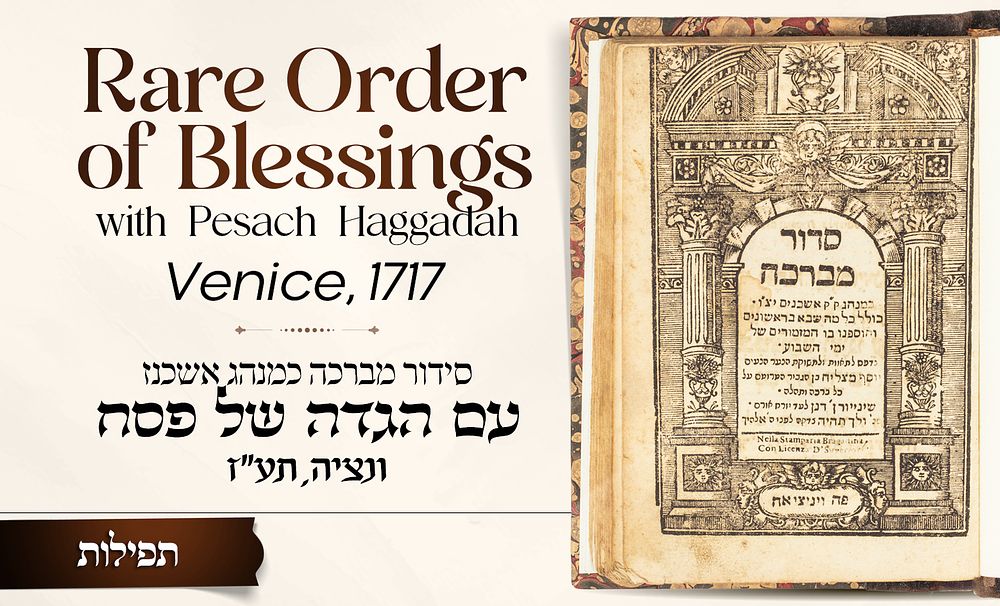
Bidspirit auction | Ashkenazic Siddur Mibracha, with the
Ashkenazic Siddur Mibracha, with the Pesach Haggadah – Venice, 1717 * A unique siddur containing commonly recited blessings together with their relevant halachos, as well as the Pesach Haggadah, “according to the custom of the holy Ashkenazic communities.” The title Siddur Mibracha was likely intended to indicate that this is not a conventional siddur containing the daily prayers of Shacharis, Mincha, and Maariv, but rather a siddur devoted specifically to the blessings recited in everyday life. Siddurim of this kind were once widespread among the Jewish communities of Italy. Due to their frequent use, however, they became increasingly rare over the years. The siddur contains blessings for the morning meal; psalms to be recited after the meal according to the days of the week; Birkas Hamazon; piyutim for the three Shabbos meals, including compositions by the Arizal; Havdalah and prayers for Motzaei Shabbos; Krias Shema al Hamitah; the lighting of Chanukah candles; a piyut for Purim; the order for a chassan and kallah, including the marriage blessings and Birkas Hamazon; bris milah; pidyon haben; the annulment of a dream; the order of kapparos; a supplication for Erev Rosh Hashanah and Yom Kippur; Tziduk Hadin; Tefillas Haderech; Eruv Tavshilin and Eruv Chatzeiros; Kiddush for Shabbos; the Pesach Haggadah (leaves 23–31); Sefiras HaOmer; Pitum Haketores; and blessings over food and other pleasures, intended to complete the daily quota of one hundred blessings. An uncommon edition, not recorded by Friedberg or Ben Yaakov. Printed in a small pocket format. Venice, 1717. Page Count: 36 leaves. Size: 15.7 cm. Pocket format. Condition: Good. The upper portion of the title-page border is slightly trimmed. Stains and characteristic signs of use. Old soft cardboard binding, partially detached. Several bibliographical sources — including Zedner, Winograd, and the National Library of Israel — mistakenly record the year of publication as 1716, having overlooked that the letter aleph was also emphasized as part of the numerical value of the date. __________ Interestingly, even though the sefer follows the Ashkenazic rite, the sefer was printed “at the desire and request of the fine youth Yosef Matzliach, son of the philanthropist… Senyor [Shneur] ibn Danan, ” who belonged to Venice’s Sephardic community. In fact, it is known that his father, Shneur ibn Danan, who was one of the leaders of the Sephardic community in Amsterdam, assisted in the publication of the large Ashkenazic machzor Hadras Kodesh, printed in Venice several years earlier. During this period, Yosef Matzliach published several small sefarim in Venice, including a calendar edited by the Rabach. Some of these works are exceedingly rare today. There is a known letter from the Ramaz to the Rabach, in which he asks him to assist the aforementioned Yosef Matzliach with a certain matter (Benayahu, Dor Echad BaAretz, p. 177).