Bidspirit auction | One of the Only Surviving
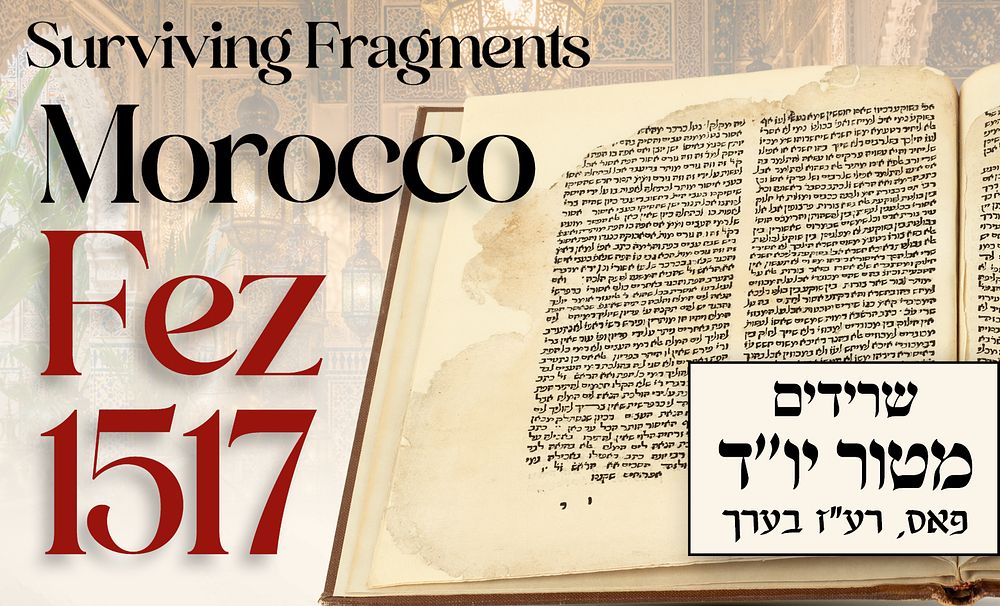
One of the Only Surviving Fragments in the World! Post-Incunabula from Morocco – Ten Leaves from the Tur, Yoreh De'ah – Fez, c. 1517 * Ten leaves from the Tur, Yoreh De'ah, by Rabbi Yaakov ben HaRosh, the Ba’al HaTurim. The Arba'ah Turim is one of the most fundamental and important halachic works ever written. It served as the basis for the sefer Beis Yosef, upon which the Shulchan Aruch was subsequently composed. For centuries, countless halachic works have analyzed its every word and letter. Presented here is a surviving fragment from an edition that is almost entirely lost, printed in Fez, Morocco, between approximately 1517 and 1521. This edition ranks among the rarest editions of the Tur ever printed. No complete copy is known to exist today. The surviving copies and fragments are scattered among only a very small number of libraries worldwide. The National Library of Israel, for example, has only a single half leaf from this edition(!) originating from the Mehlmann collection. The most complete surviving copy is held in the Schocken Collection, yet even that copy is incomplete. A once-in-a-lifetime opportunity to acquire an extraordinary relic from one of the most fascinating and important Hebrew printing presses, active during the generation immediately following the incunabula period. Fewer than ten Hebrew books were printed in Fez during the late 1510s and early 1520s, all of them exceptionally rare, and several survive only in fragmentary form. The printer there was Shmuel Nedivot , whose name appears explicitly in only one book — Sefer Abudraham, printed in Fez in 1516. Based on typographical comparison, scholars have attributed several additional editions to his printing press, primarily Talmudic tractates and sections of the Tur. It appears that Nedivot arrived in Morocco following the Expulsion from Spain and Portugal, which brought waves of Torah scholars, intellectuals, and highly skilled craftsmen to Morocco, Constantinople, and Salonika. The above-mentioned sefer Abudraham was printed from remarkably similar printing blocks, with precisely the same page layout as the Lisbon 1490 edition printed in Portugal before the Expulsion. An incomplete copy of the Fez Abudraham was sold by Genazym five years ago – see genazym.com Following this brief but remarkable period of Hebrew printing in Fez — of which the present leaves are a rare surviving witness — Hebrew printing in Morocco ceased entirely for nearly four hundred years! Fez, c. 1517. Shmuel Nedivot Printing Press . Page Count: Ten leaves in total, covering simanim 125–204. Most of the text is continuous, with no missing leaves between the surviving sections. The numbering of the simanim in this edition differs slightly from the numbering used today in standard editions. The leaves have been bound together and consist of two groups: The first five leaves retain wide margins but have loss of text at the top of the pages. Paper has been added to the margins for uniformity. Size , including the paper restorations: 20 × 28 cm. The final five leaves have short margins, with the text preserved almost in its entirety. Marginal repairs. Size: Approx. 17 × 24.4 cm. Condition: Fair. Text loss, holes (with loss of text), and repairs. Bound together in an old binding with a leather spine with a few holes. Bibliography: Institute for Hebrew Bibliography, record no. 328524 (described there as “likely printed between 1517 and 1521”); Ginzei Yisrael (Mehlmann collection), no. 726 (dated there: c. 1515–1521); Otzar HaSefer HaIvri (Winograd), Fez, no. 1; HaSefer VeHaDefus HaIvri BeFez, p. 82, no. 7 (listing five incomplete surviving copies; the entry contains minor inaccuracies); Bnei Melachim: Toldos HaSefer HaIvri BeMorocco, p. 35, no. 7. For further discussion of Hebrew printing in Fez during these years, see the latter two sources, as well as Chaim Dov Friedberg's History of Hebrew Printing in Italy, pp. 143–144. (Friedberg does not list the present edition, as it was unknown to him at the time, nor does it appear in his book Beit Eked Sefarim.)