Bidspirit auction | Rare and Historic: Chesed Shmu-El
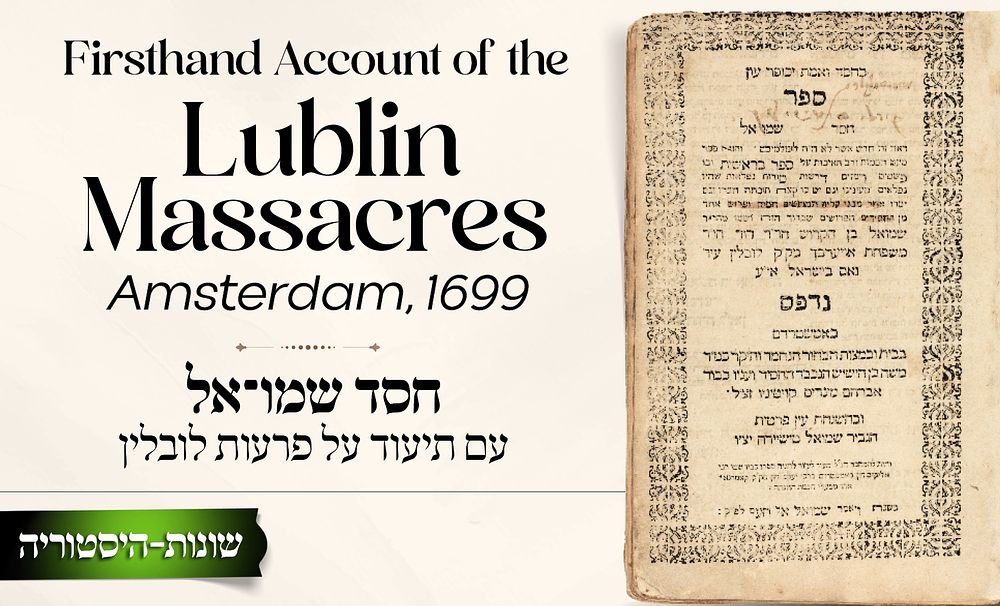
Rare and Historic: Chesed Shmu-El by a Survivor of the Lublin Massacres – With an Account of the Massacres – Amsterdam, 1699 * A homiletic and kabbalistic work containing chiddushim and words of mussar on the parshiyos of Sefer Bereishis, following the approaches of pshat, remez, drush, and sod, by Rabbi Shmuel ben Rabbi Dovid Auerbach Hy”d of Lublin. In his introduction, the author recounts the miraculous manner in which he survived the massacres in Lublin in 1655, during which thousands of Jews were killed. On the last page of the sefer, he offers an explanation of the pasuk “We were like sheep for the slaughter, ” and then writes about “the holy martyrs of the holy community of Lublin, who suffered harsh decrees almost daily… like sheep led to the slaughter.” He continues with a moving and painful description of the cruel deaths suffered by several tzaddikim, whom he identifies by name. Because of their historical importance, these passages were reprinted numerous times in sefarim and studies dealing with the massacres. The most famous massacres of that era are those of 1648–1649, yet additional waves of massacres swept through Poland and Lithuania in the following years as a result of the wars between the Swedes and the Poles. One particularly devastating massacre took place in the illustrious community of Lublin on the eve of Sukkos, 1655, leaving a deep and lasting scar upon Polish Jewry. A rare sefer. Singular edition. The author, Rabbi Shmuel Auerbach , was one of the sages of Lublin in the seventeenth-century. He miraculously survived the Lublin massacres of 1655 and was later saved a second time, as he describes in his introduction. His father, Rabbi Dovid, was apparently killed in one of the massacres. Rabbi Shmuel made a promise to travel to Eretz Yisrael, and printed the present work while passing through Amsterdam, where he received approbations from both the Ashkenazic and Sephardic rabbanim of the city. In addition to this sefer, he also composed a kinah in memory of the victims. In the sefer, he cites kabbalistic teachings from the writings of Ashkenazic kabbalists, including Shefa Tal, Megaleh Amukos, the Shelah, Yalkut Reuveni, and others. Rabbi Shmuel deliberately called the work Chesed Shmu-El rather than Chesed Shmuel, explaining in his introduction: “I have called it Shmu-El, for whoever studies and fulfills its teachings is assured that G-d will be with him.” Amsterdam, 1699. Singular edition. Page Count: [1], 43 leaves. Size: 17.6 cm. Condition: Good to good-fair. Some headings are trimmed. Wear and stains. Antique binding from the period of printing, partially damaged. - - - - - - - - - The author offers a striking interpretation of the verse “For Your sake we are killed all day.” How, he asks, can a person be killed “all day” if he can die only once? He explains that the verse is to be understood literally, having personally witnessed how a righteous Jew of Lublin was tortured throughout an entire day before finally dying. This, he writes, is the meaning of “we are killed all day” — a killing that continues over the course of the entire day. May Hashem swiftly avenge the spilled blood of His servants. - - - - - - - - - Signatures and ownership inscriptions at the beginning of the sefer: On the inside front cover: “This sefer was given to me as a gift for a drasha from the rav of the holy community of [P?]”B, יום ב' חשון תע”דל” On the front flyleaf: “Hakatan Chaim son of Rabbi Yitzchak, of the holy community of Brody.” “To Hashem belongs the earth and all that fills it… Hakatan Eliyahu son of the noble Rabbi Zalman.” “This sefer, Chesed Shmuel, belongs to the bachur and scholar Reb Hershel son of Rabbi Shimon [of Furth?]. I purchased it from Nosson [of Furth?]… through Rabbi Zeligman [of Furth?] Klauzner…” “A shield to all who sign within it. Hakatan Kalonymus son of Reb Shimon Bloch z”l of Furth” “Hakatan Kalonymus Bloch.” “A shield to all who sign within it. I purchased it from Avraham… Hakatan Ze’ev Wolf son of Reb Yisrael zt”l” On the title page: “Moshe [surname unclear].” Several titles of honor adjacent to the author’s name on the title page have been erased.