Bidspirit auction | Otzar HaKavod – With Rare
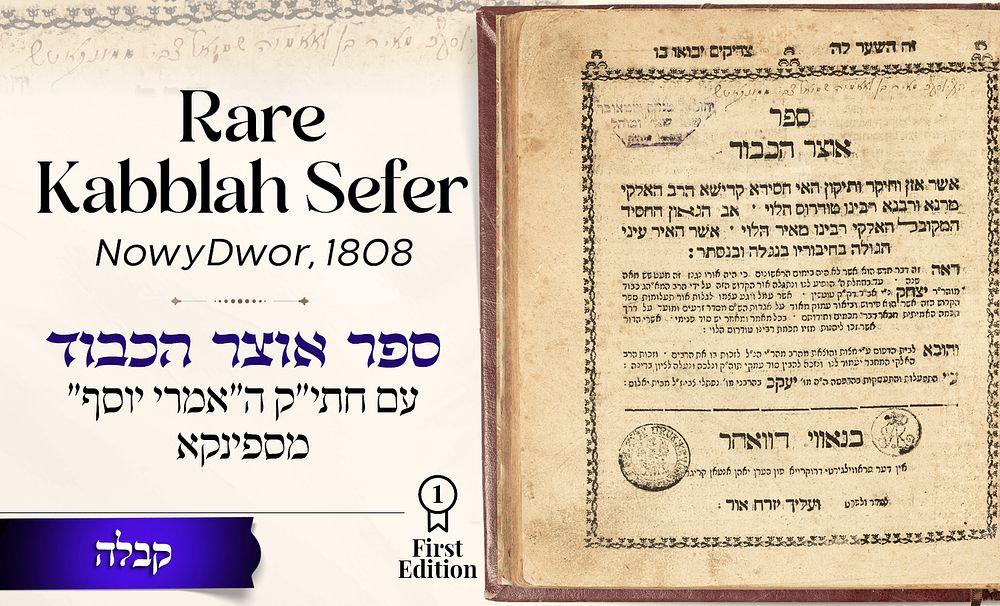
Otzar HaKavod – With Rare Chassidic Approbations – Signed by the Imrei Yosef of Spinka. Nowy Dwor, 1808. First Edition. * Otzar HaKavod, a Kabbalistic commentary on the Aggadic passages of the Gemara in Seder Zeraim and Seder Moed, by Rabbi Todros HaLevi Abulafia, one of the greatest Rishonim of Spain during the era of the Rashba and a nephew of the Remah. First edition, printed centuries after the author’s passing. The greatest kabbalists were already familiar with this work in manuscript form. It is cited in Avodas HaKodesh by Rabbi Meir ibn Gabbai and in the Pardes Rimonim of the Ramak, who refers to its author as one of the greatest kabbalists among the Rishonim and Geonim whose teachings may be relied upon (see Pardes Rimonim, Ahavas Shalom edition, p. 889). “I know that every Torah scholar, every diligent student immersed in the Torah, and every chassid and devout Jew will welcome this holy sefer with great joy” (from the approbation of Rabbi Eliezer Dovid Greenwald, Av Beis Din and Rosh Yeshiva of Satmar, to the Satmar 1926 edition of Otzar HaKavod). The opening pages contain a remarkable collection of important Chassidic approbations. Among them are the approbation of the holy Maggid of Kozhnitz , as well as an exceptionally long and rare approbation by Rabbi Naftali Tzvi of Ropshitz, written at the instruction of his teacher, Rabbi Menachem Mendel of Rimanov. The new edition of Menachem Tzion and Yalkut Menachem (Jerusalem, 2007) documents only two approbations issued by Rabbi Menachem Mendel of Rimanov: one for Ohr Pnei Moshe by the Rebbe of Pshevorsk, and one for Orach LaChaim by the Rebbe of Zlotshov. The present approbation, written in his name, constitutes a third. Only about five approbations are known from Rabbi Naftali Tzvi of Ropshitz, and this is the longest of them; two of the others consist of little more than a single line. At the bottom of the approbation page, it is recorded that the Chozeh of Lublin declined to write a formal approbation because he had undertaken never to do so. Nevertheless, “out of his great longing for this holy sefer, Otzar HaKavod, he signed the register of signatories… and his signature shall stand in place of an approbation.” The title page bears the autograph signature of the Imrei Yosef of Spinka: “Hakatan Yosef Meir, son of my revered father and teacher, Shmuel Tzvi of Munkatch.” Rabbi Yosef Meir Weiss of Spinka, the author of Imrei Yosef (1838–1929), was a leading Chassidic Rebbe and the primary disciple of Rabbi Yehudah Aryeh Leib of Ziditchov, from whom he received an extensive transmission of Kabbalah, and who ordained him as a Rebbe. Even after his teacher’s passing, he would appear to him in dreams. His mastery of Kabbalah was renowned, and even his contemporary, Rabbi Chaim of Sanz, consulted him on Kabbalistic matters. “He brought about countless great salvations through his blessings, granted children to the barren through his prayers, healed the sick through his supplications, and pierced the heavens with his words. I can almost say that every word that emerged from his holy lips was fulfilled...” (From the introduction by his son, the Chakal Yitzchak, to the Imrei Yosef). His Torah teachings were published in the Imrei Yosef series on the Torah and festivals, while his life and miracles are recorded in the sefer Pe’er Yosef (Sighet, 1934). Nowy Dwor , 1808. First edition. Page Count: [2], 48 leaves. Height: 21 cm. Condition: Tiny holes in the margins of some leaves. Stains. Minor restoration to the margins of the title page. Leaves 5–6 are bound twice. Ownership stamp on the title page: “Yechezkel Pinchas Stauber, shochet and bodek, shaliach tzibbur and mohel, Tzfas.” Bound at the end of the volume is another work: Sefer HaChaim by Rabbi Chaim ben Betzalel, the elder brother of the Maharal of Prague. On the verso of its title page there is a fine approbation by the Ohev Yisrael of Apta, previously printed in the Mezhibuzh edition of 1817. Lvov, c. 1830. Page Count: [1], 30, [3] leaves. Height: 21 cm. The two sefarim are now bound together in a new binding. It is not known whether they were already bound together when owned by the Imrei Yosef — in which case Sefer HaChaim would likewise have belonged to him. It is, however, highly likely that the two volumes have been bound together for a very long time.