Bidspirit auction | Rare! An Early Hebrew–English–Spanish Dictionary
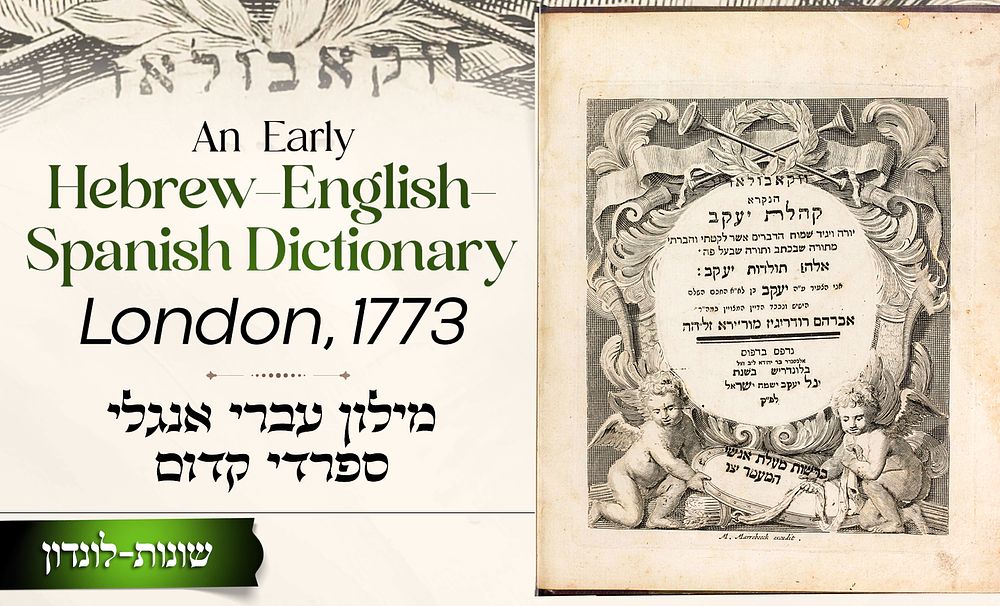
Rare! An Early Hebrew–English–Spanish Dictionary – Featuring America as One of the Four Corners of the Earth! London, 1773 * A book on “vocabulary” called Koheles Yaakov – a trilingual dictionary containing more than four thousand words, covering a wide range of everyday subjects, by Rabbi Yaakov Rodriguez Moreira. The entire work is printed in three languages — Hebrew (with vowels), English, and Spanish — in three parallel columns. The dictionary was intended to help the Jews of its time and place learn Lashon HaKodesh. Most were fluent in either Spanish or English but had only a limited command of Hebrew. It also provided Hebrew equivalents for foreign terms that had entered common usage over the centuries and naturally had no counterparts in Tanach. The work is divided into fifty-eight chapters, each devoted to a particular subject and containing the most common and practical vocabulary related to that topic. Among them are: the Names of Hashem (Chapter 1), Ships and Their Officers (Chapter 8), the Seasons of the Year (Chapter 28), the Mishkan, the Beis Hamikdash and Its Vessels (Chapter 30), Musical Instruments (Chapter 39), and many more. Several chapters contain independent historical material – for example, Chapter 50 includes a chronological account of the Judges of Yisrael, a list of converts throughout the generations, and the Seven Noahide Commandments. One of the book’s most fascinating features is the author’s remarkably literal interpretation of the phrase “the four corners of the earth, ” identifying the continent of America as one of them! On page 8, under the heading “The Four Corners of the Earth, or the Parts of the Inhabited World, ” he lists: “The Corner of Asia, the Corner of Europe, the Corner of Africa, and the Corner of America.” The accepted understanding of the expression “the four corners of the earth” is that it refers to the four directions — east, west, north, and south. Over the years, the dictionary has acquired additional importance, as it preserves distinctive Hebrew words and expressions that have long fallen out of use. For example, a telescope is called “Kaneh HaHabatah” (“viewing tube”), while an anchor is referred to as “Eleg HaTikvah”. This is one of the earliest Hebrew–English dictionaries and likely the first Hebrew–English–Spanish dictionary ever published. At the beginning of the volume there is an approbation from the Sephardic Chief Rabbi of London, Rabbi Moshe HaKohen Diazivido. It is also one of the earliest Hebrew books printed in London by Jewish printers. Hebrew printing in London under Jewish ownership began only in 1770, a mere three years before this volume was published. The title page is an attractive and uncommon engraved copperplate. London, 1773. Singular edition. Page Count: [23], 183 pages. Three title pages: Hebrew, English, and Spanish. Size: Medium format. Condition: Good. A few small paper repairs on the first and last leaves. Well-preserved binding.