Bidspirit auction | Shu”t Rosh Yosef Frankfurt an
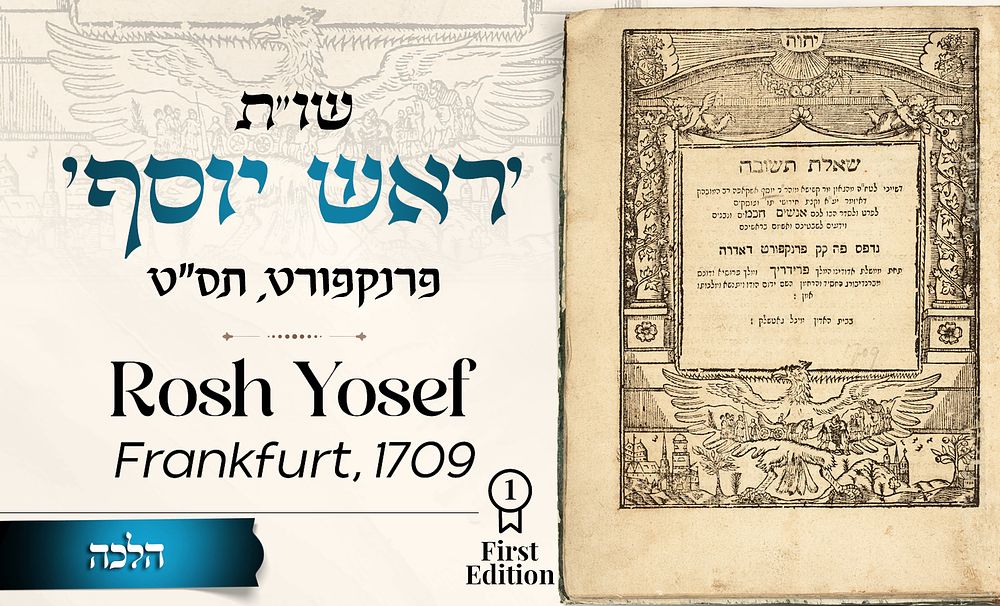
Shu”t Rosh Yosef Frankfurt an der Oder, 1709. First Edition. * She'eilas Teshuvah – a sefer of responsa on Tur Choshen Mishpat by the renowned Rabbi Yosef Eskapa, the well-known Rav of Izmir (Smyrna) for many decades. Rabbi Yosef Eskapa (c. 1571–1662) was one of the leading Torah sages of the Ottoman Empire in the seventeenth century. He studied in Constantinople under Rabbi Yosef of Trani (the Maharit) and was a friend of Rabbi Chaim Shabbtai (the Maharchash). He served as the first Rav of Izmir together with Rabbi Azariah Yehoshua. He lived to an advanced age, and therefore became known as “Mar Kashisha” (“the venerable elder”). The author of Chikrei Lev writes of him: “Moreinu Harav Hagadol… whose teachings have sustained the Torah life of our city” (Choshen Mishpat, siman 2). He is best known for his monumental work Rosh Yosef on the Four Turim and selected passages of the Rambam. Only portions on Tur Orach Chaim and Tur Choshen Mishpat were printed during his lifetime (Izmir, 1658–1659). Numerous halachic rulings by Rabbi Yosef are cited by the author of Knesses HaGedolah, who became one of the leading rabbanim of Izmir following the passing of the Rosh Yosef. The Rosh Yosef and Shabbtai Tzvi The false messiah Shabbtai Tzvi studied in the Rosh Yosef's yeshiva, one of the prominent yeshivas of its day. Already from a young age, Shabbtai conducted himself in bizarre ways, claiming that his practices were based on Kabbalah. His teacher, the Rosh Yosef, excommunicated him and even ruled that he could be killed, “for he is destined to lead the masses astray and establish a new religion, ” as recorded by Rabbi Yaakov Sasportas in his sefer Kitzur Tzitzas Novel Tzvi (Amsterdam, 1737, leaf 85a). Rabbi Yosef passed away several years before Shabbtai Tzvi proclaimed himself the messiah, an event that occurred only after his meeting with Nathan of Gaza in 1665. At the beginning of the sefer there is an approbation by Rabbi Chaim Algazi, author of Bnei Chayei, which is itself a halachic discourse analyzing the prohibition against encroaching upon another person's rights. Frankfurt an der Oder, 1709. First edition. Page Count: [2], 38 leaves. Medium format. Condition: Good. Some stains and wear. Worn old binding. - - - - - - - - - - - It was highly unusual in this period for the first edition of a sefer by a Sephardic Torah scholar to be printed in Germany. The reason lies in the remarkable life story of the publisher, as he relates in his introduction. He was among the Jews expelled from Vienna in 1670. From there, he traveled to Ofen (Buda, today part of Budapest), then under Ottoman rule, remaining there until the city was captured by the Austrians in 1686. He subsequently made his way to Izmir, where he stayed with the son of one of the Rosh Yosef's disciples. During his visit he discovered a manuscript containing what he describes as “a tremendous and awe-inspiring work” of responsa by Rabbi Yosef. He was so impressed that he resolved to select a number of the responsa for publication whenever the opportunity arose. After eventually returning to Germany, he succeeded in publishing them — resulting in the rare first edition offered here.