Bidspirit auction | Exceptionally Rare: Gedolei Gidulim by
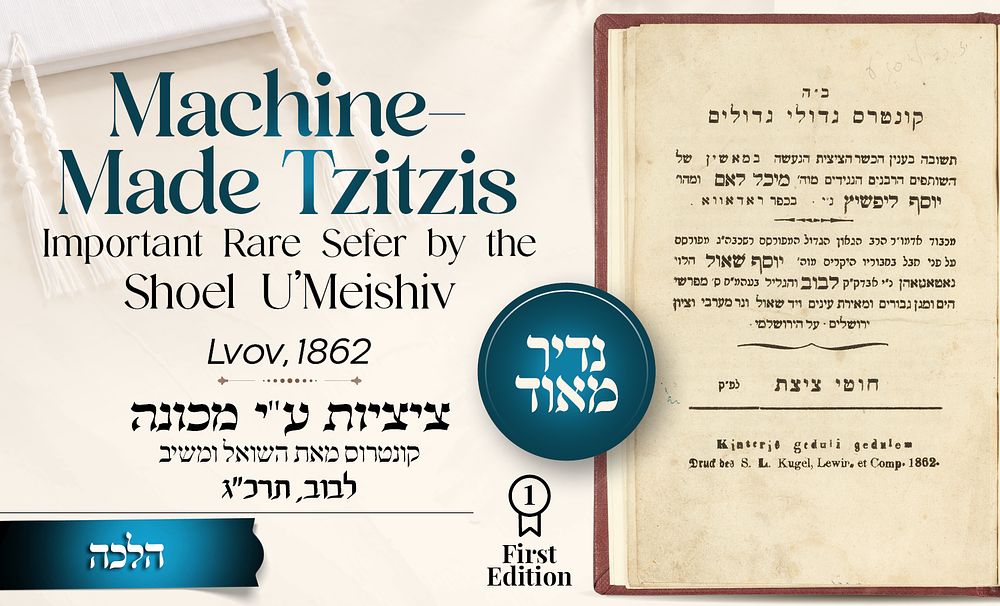
Exceptionally Rare: Gedolei Gidulim by the Shoel U’Meishiv – The Controversy over Machine-Made Tzitzis – Lvov, 1862 * A small pamphlet containing a halachic teshuva by the Gadol Hador Rabbi Yosef Shaul HaLevi Nathanson of Lvov, author of Shoel U’Meishiv. In this teshuva, the Shoel U’Meishiv rules that tzitzis strings may be manufactured by a machine operated by observant Jewish workers, concluding that “these tzitzis are kosher, even mehadrin min hamehadrin [according to the strictest standards].” An exceedingly rare pamphlet, quite literally one of the only known copies in the world. At present, only two copies are known: the present copy, and another copy that was in the Heichal Shlomo Library in 1967, whose present whereabouts are unknown (see Shanah BeShanah, 1967, pp. 273–274, where it is noted that the pamphlet contains three pages!). The pamphlet was recorded by the Institute for Hebrew Bibliography based on the present copy. The overwhelming majority of bibliographers never saw it and did not record it in their works, including Otzar HaSefarim by Ben-Jacob, Beis Eked Sefarim by Friedberg, and Winograd’s Otzar HaSefer HaIvri. It is not found in the National Library of Israel and is likewise absent from the international WorldCat database. The Machine-Made Tzitzis Controversy A new factory for the production of talleisim was established in the village of Radawa near Jarosław. The owners proposed manufacturing the tzitzis strings — which must be prepared “lishmah” (with specific intent for the mitzvah of tzitzis) — by means of a machine operated through human power. Seeking rabbinic approval, the factory owners approached the Shoel U’Meishiv and his beis din and requested that they personally inspect the machine and determine whether it could be used for the preparation of kosher tzitzis. The members of the beis din undertook the journey to the village in Kislev 1862, where they carefully examined the machine and its operation on two separate occasions. They recorded a remarkably detailed technical description of the mechanism, which occupies more than two pages at the beginning of the teshuva. The Shoel U’Meishiv ultimately ruled that since every movement of the machine was generated directly through the action of a qualified and trustworthy Jewish operator, the resulting tzitzis were fully kosher, even according to the highest standards of halachic stringency. The teshuva was printed that same year as a separate pamphlet under the title Gedolei Gidulim — the present work. The ruling was endorsed by supporters such as the Chesed LeAvraham of Buczacz, but it also generated significant opposition. One of the most prominent opponents was the Sanzer Rebbe, author of Divrei Chaim, who had personally seen the present pamphlet. In one of his teshuvos, he writes that his eldest son, the Av Beis Din of Shinova, had carefully investigated the machine and found that it did not operate in the manner described in the pamphlet of “the gaon Rabbi Yosef Shaul, ” but rather in a different fashion that rendered its use invalid. Two teshuvos opposing the machine were subsequently printed in Shu”t Divrei Chaim, Orach Chaim, part II, nos. 1–2. It is noteworthy that after the first teshuva in Divrei Chaim on the subject was published, the publishers appended the following remark: “Only a few days later, the entire machine-house burned down in a great fire causing great loss, and it served as a sign...” The pamphlet was reprinted from the present copy in Etz Chaim (Brooklyn), Year 4, Issue 2 (11), Nissan 2010. See also Issue 9 for an extensive discussion of the Divrei Chaim’s position on the matter. Lemberg, 1862. First edition and singular edition as a standalone pamphlet. Page Count: [7] leaves. Size: Approx. 18 cm. Condition: Good. Stains. New binding. Kuntres Gedolei Gidulim