Bidspirit auction | Osiyos D’Rabbi Yitzchak – A
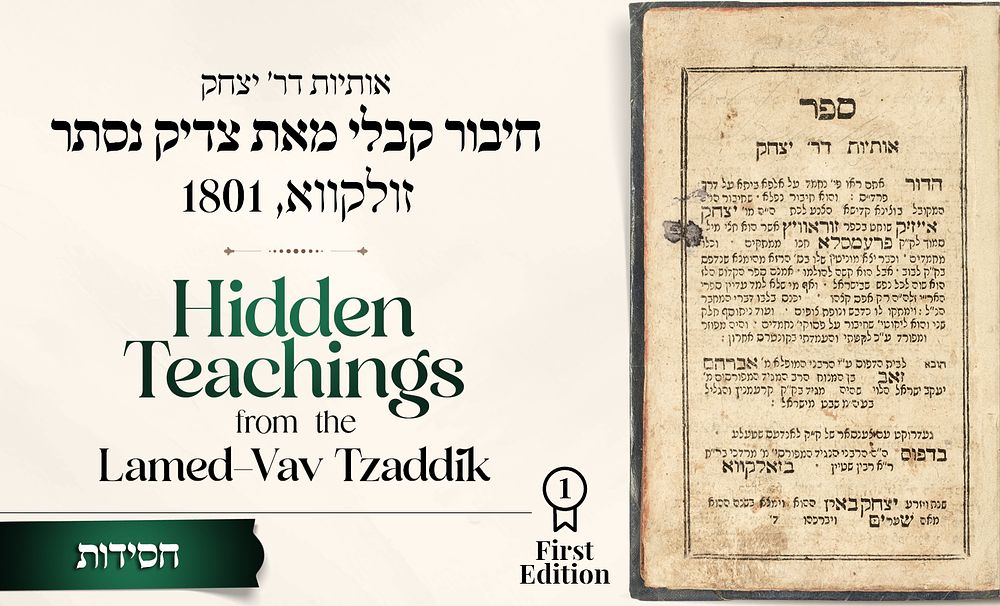
Osiyos D’Rabbi Yitzchak – A Kabbalistic Work by a Hidden Tzaddik, Preserved in the Merit of the Yismach Moshe Zolkova, 1801. First Edition. * A Kabbalistic work on the letters of the Hebrew alphabet, exploring their inner essence, spiritual roots, and mystical significance. The work was composed by the hidden tzaddik Rabbi Yitzchak Isaac, the shochet of the village of Zorowitz. It was said that tears streamed from his eyes while performing shechitah, and the tzaddikim of his generation testified that through his shechitah he was able to rectify the soul that had become reincarnated in the animal. Printed at the beginning of the sefer is a rare approbation by Rabbi Moshe Leib of Sassov, who writes: “I have seen several pages, and rejoiced greatly, for they are delightful and sweeter than honey.” This work was originally intended to be buried together with its author, but was preserved for future generations through the intervention of the Yismach Moshe of Ujhely. Before his passing, the author instructed that all of his manuscripts be interred in his grave. The Yismach Moshe — then a young man of only about twenty-five years of age — acted immediately. He hired scribes to copy the entire collection, placed the copies in the grave in fulfillment of the author’s wishes, and retained the original manuscripts in his possession. The Yismach Moshe entrusted the manuscripts to the renowned maggid Rabbi Yaakov Yisrael HaLevi of Kremnitz, author of Shevet MiYisrael, who published from them the sefer Raza Mehimna (Lvov, 1791). This extraordinary episode is mentioned briefly in the publisher’s introduction to Raza Mehimna and is recounted at greater length, with additional interesting details, in the sefer Pe’er VeChavod (Munkacs, 1911). The present volume contains another previously unpublished portion of the author’s teachings, printed from the remaining manuscripts by Rabbi Avraham Zev, son of the Maggid of Kremnitz. The author, the hidden tzaddik Rabbi Yitzchak Isaac HaLevi (1735–1783) , was the author of Raza Mehimna, Osiyos D’Rabbi Yitzchak, and Yesod Yitzchak. He served as a shochet and bodek in the village of Zorowitz near Przemyśl, lived in great poverty, and remained almost entirely unknown during his lifetime. As later recorded, “No one knew the greatness of his spiritual stature or the extent of his holiness until shortly before his passing.” Only then did his reputation spread among the tzaddikim, and the approbations to his sefarim lavish extraordinary praise upon him as a hidden tzaddik and an exceptional kabbalist. In a highly unusual occurrence, his sefarim received approbations from all of the leading Torah authorities of the generation, who were deeply impressed by the Torah of this unknown hidden tzaddik. Among them were Rabbi Moshe Leib of Sassov, the Ketzos HaChoshen, Rabbi Ephraim Zalman Margulies, Rabbi Yaakov Orenstein, and many others. Among the remarkable tributes to the author: Rabbi Meshulam HaKohen, Av Beis Din of Lvov, testified that his brother, Rabbi Yitzchak Isaac HaKohen of Ostroh, author of Bris Kehunas Olam, declared: “The spirit of Hashem rested upon this author.” Rabbi Mendel of Zolkova, one of the kabbalists of the Brody kloiz, wrote: “From his style and writings... it appears possible that he experienced Divine revelation.” Rabbi Ephraim Zalman Margulies, author of Beis Ephraim, described him as: “A holy man of G-d, master of the hidden mysteries, modest in all his ways — none like him was found in his generation; a faithful kabbalist, whose good name surpassed even the finest oil... It was always his way to remain hidden from public view.” Zolkova, 1801. First edition. Page Count: [4], 36, 12 leaves. Height: Approx. 18 cm. Condition: Good. A few holes and stains. New binding. Bibliography: Stefansky, Sifrei Chassidus, no. 37. This is the copy photographed there. Between the leaves are more than ten handwritten annotations. Most concern the placement of particular passages, indicating that, in the annotator’s opinion, they belonged elsewhere in the sefer — clear evidence that the volume was studied in great dept h. The annotator’s identity is unknown. On leaf 10a, there is a signature, incorporated into the printed page count: “[Y]aakov.”