Bidspirit auction | Controversy of Corfu Mamzerim: The
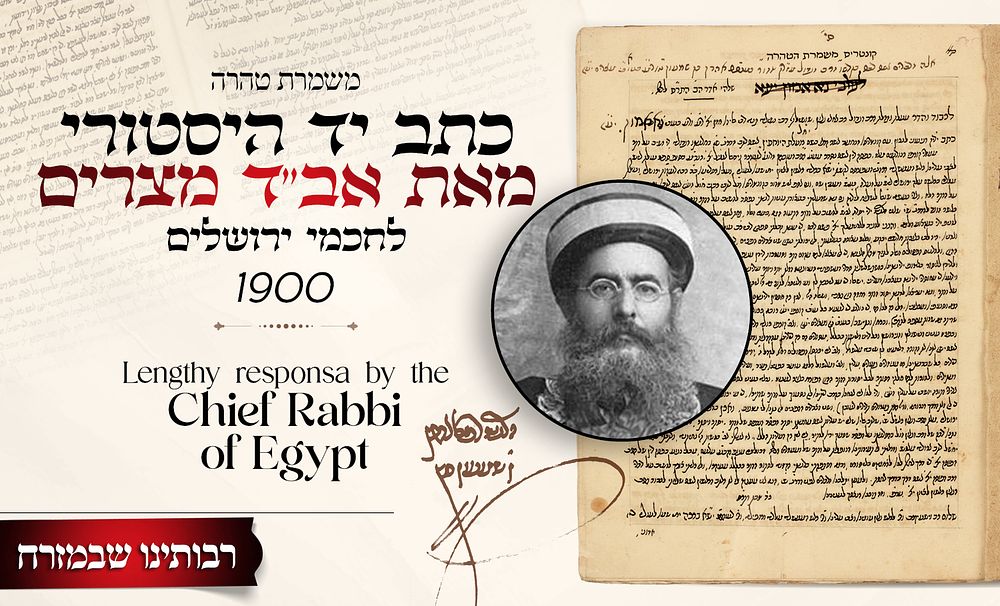
Controversy of Corfu Mamzerim: The Landmark Handwritten Kuntres by Rabbi Raphael Aharon Ben-Shimon, Chief Rabbi of Egypt – With Unpublished Sections – 1900 * Mishmeres HaTaharah – a lengthy 44-page kuntres in the elegant handwriting and with the signature of Rabbi Raphael Aharon Ben-Shimon, Chief Rabbi of Egypt, author of Nahar Mitzrayim and one of the well-known Sephardic sages of the nineteenth century. The kuntres contains a major halachic campaign against the rabbanim of Jerusalem who had ruled that a family from the island of Corfu, long regarded as bearing the status of mamzerim, could marry into the Jewish community. At the beginning of the work, Rabbi Raphael Aharon copied various documents relating to the controversy, including the letter he sent to the Rishon LeTzion Rabbi Yitzchak Shaul Elyashar (the Yisa Bracha), the letter that sparked the debate. This is one of the central and most influential teshuvos in the controversy, through which the opponents of the ruling – led by Rabbi Raphael Aharon – succeeded in persuading the rabbanim of Jerusalem to retract their original decision. Rabbi Raphael Aharon sent the kuntres to his colleague Rabbi Eliyahu Chazan, Chief Rabbi of Alexandria and author of Ta’alumos Lev, who had joined him in the struggle, so that it could be printed in the third volume of Ta’alumos Lev (Alexandria, 1903). Rabbi Raphael Aharon later reprinted it in his own sefer, U’Matzor Devash (Jerusalem, 1912). On leaf 3a there is a passage that apparently was never printed, followed by two additional sections omitted from Ta’alumos Lev and later printed in substantially revised form in U’Matzor Devash. Together they comprise approximately a full page of previously unpublished text. See below. The Corfu Mamzerim A family residing on the island of Corfu had long been regarded as bearing the status of mamzerim, and the Jewish community refrained from marrying them. In 1899, members of the family approached rabbanim seeking to determine whether any remedy existed or whether the basis for their disqualification could be challenged. The Sephardic rabbanim of Jerusalem, headed by the Rishon LeTzion Rabbi Yitzchak Shaul Elyashar, investigated the matter and concluded that the family was permitted to marry within the Jewish community. The documentation, evidence, and halachic rulings supporting this conclusion were printed by the Yisa Bracha that same year in Jerusalem at the end of his sefer Olas Ish. When the two leading rabbanim of Egypt, Rabbi Raphael Aharon Ben-Shimon, Chief Rabbi of Egypt, and Rabbi Eliyahu Chazan, Chief Rabbi of Alexandria, learned of the ruling, they undertook a determined effort to restore the original prohibition. Since many residents of Corfu were immigrants to Egypt, the rabbanim feared for the lineage of their communities should marriages take place with members of that family. For an entire year, from Teves 1900 until Teves 1901, the two Egyptian rabbanim together with additional rabbanim from Italy waged what Rabbi Raphael Aharon described as “a fierce battle with the holy and venerable rabbanim of the Land of Israel.” Rabbi Raphael Aharon, a remarkably quick writer, composed hundreds of letters concerning the affair, as he later relates in U’Matzor Devash. Ultimately, after Rabbi Raphael Aharon presented his arguments at length and with great clarity, the rabbanim of Jerusalem withdrew their original ruling and sent a letter to Corfu announcing their retraction. In Rabbi Raphael Aharon’s words: “Then we declared, fortunate is the generation in which the great heed the words of the lesser.” An important manuscript of historical significance for a halachic controversy that today has almost entirely been forgotten. Rabbi Raphael Aharon Ben-Shimon (1847–1929) was born in Jerusalem to the distinguished Rabbi Dovid Ben-Shimon, known as the Tzuf Dvash and author of Sha’ar HaChatzer. In 1888 he traveled twice as an emissary on behalf of the North African community of Jerusalem. In 1891 he was appointed Chief Rabbi of Egypt, where he devoted himself tirelessly to the community and waged a determined battle against the new influences spreading throughout the country. In 1921 he returned to his native Jerusalem, where he passed away. Among his well-known works are Nahar Mitzrayim and Tuv Mitzrayim. His descendants included prominent rabbanim, among them the brothers Rabbi Masoud Ben-Shimon and Rabbi Nissim Ben-Shimon. Their late sister was the wife of Rabbi Shalom Cohen, Rosh Yeshivas Porat Yosef. Egypt, 1900-1901 Page Count: 22 leaves, written on both sides. Total of [44] pages in the handwriting and with the signature of Rabbi Raphael Aharon. Height: 22.3 cm. Condition: Good. Hole running through the leaves. A few stains. Old paper wrappers with light tears.