Bidspirit auction | Unpublished Autograph Manuscript – Discourses
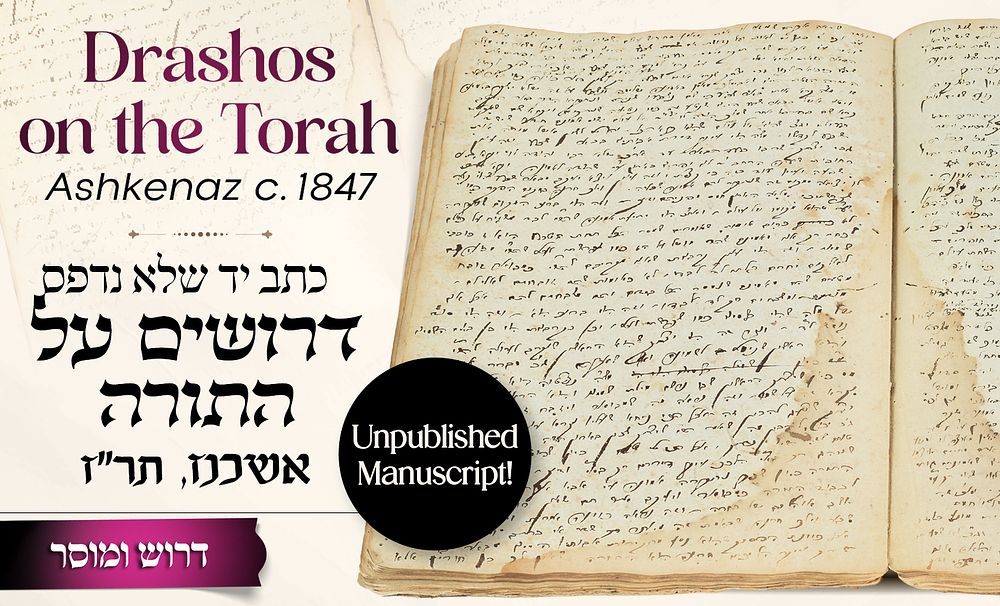
Unpublished Autograph Manuscript – Discourses on the Torah – Ashkenaz, c. 1847 * Autograph manuscript in large format, comprising 122 written pages of homiletic discourses on the Torah, together with drashos for special occasions: a bris milah, eulogies, and siyumim. In one section, the author also records an analysis of a sugya in Shas. In the author’s handwriting, with additions and corrections. One of the discourses is dated 1847. The author’s identity is unknown. He was likely a Rav serving in one of the towns of Central Europe. Much of the work is devoted to matters of faith and Jewish thought, discussing the fleeting nature of this world, the immortality of the soul, the eternity of the Creator, the greatness of Torah, and related themes. In one passage, the author writes of “many tzaddikim whose entire vitality comes solely from Torah and mitzvos, ” and, in that context, mentions “the Gaon Reb Akiva, of whom all the doctors say this.” He may be referring to Rabbi Akiva Eiger of Posen, who passed away in 1837. This manuscript has never been published. Ashkenaz, c. 1847 . The manuscript comprises [64] leaves, with [122] handwritten pages in the author’s handwriting. Height: Approx. 31.5 cm. Condition: Fair to good. Holes throughout the manuscript. A stain in the margins, at times causing noticeable fading of several words. Original binding, detached and worn. - - - - - - - - - The Author’s Style In many drashos, the author references his other drashos with phrases such as “as I explained above, ” “as I shall explain below, ” and “as I wrote elsewhere.” A distinctive term in his writing is his repeated use of the word “kavanah” in the sense of “interpretation” or “explanation.” He writes: “As I elaborated in the kavanah (explanation) of VeShomru Bnei Yisrael”; “this appears to be the kavanah (meaning) of ‘For on the day you eat from it’”; “this is the kavanah (explanation) of ‘To know what was in your heart’”; and “according to the approach I explained above, this can now be explained with greater kavanah (more concisely).”