Bidspirit auction | Foundational Work of Jewish Thought:
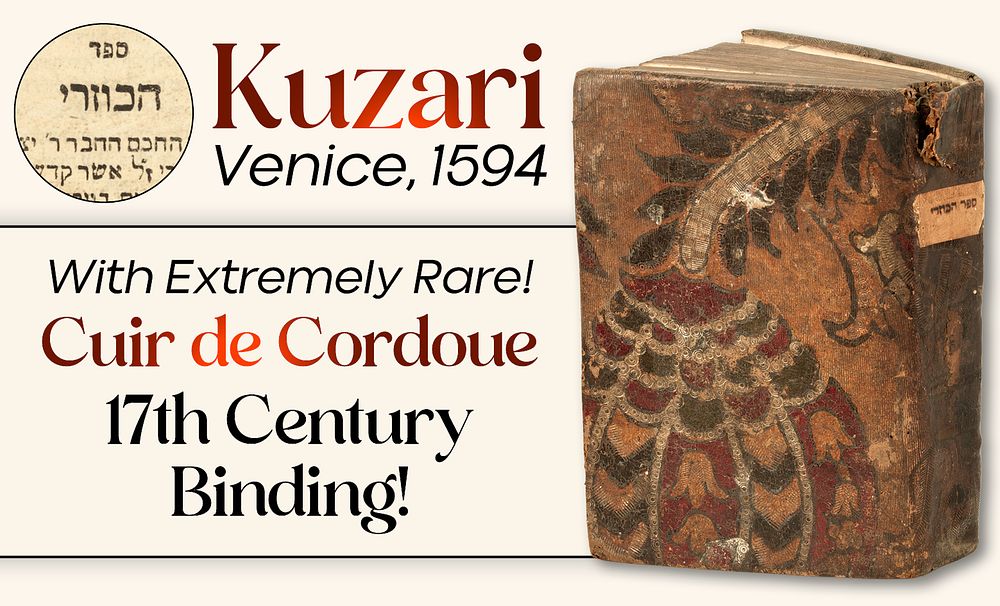
Foundational Work of Jewish Thought: Kuzari - Venice, 1594. Bound in an Antique Artistic Binding – Exquisite and Rare * Sefer Kuzari by the sage and poet Rabbi Yehuda HaLevi, presenting the fundamentals of Jewish belief in the form of a debate between the King of the Khazars and a Jewish sage known simply as “the chaver.” Sefer Kuzari is universally recognized as one of the most foundational works of Jewish thought. This edition contains the first appearance in print of the commentary Kol Yehudah by the famous darshan Rabbi Yehuda Moscato, one of the leading Italian rabbanim in the late sixteenth century and author of Nefutzos Yehudah. Kol Yehudah was the first commentary ever printed on Kuzari and remains the most important of the many commentaries published in later generations. Venice, 1594. First edition of Kol Yehudah. Page Count: 299 leaves. Condition : Good to good-fair. Numerous stains in the margins. One leaf has an original printing flaw affecting a few words. Headings are trimmed on several leaves. Bibliography : Stefansky, Sifrei Yesod, notes to no. 495. - - - - - This copy has been preserved for centuries in an exceptional decorative binding: A gilt leather binding from approximately the seventeenth century, decorated with an elaborate floral design covering nearly the entire front of the binding, painted in shades of orange-gold, crimson, and deep green, with delicate gilt embossing. An exceptionally rare artistic binding of a type seldom encountered! - - - - - The Artistic Leather Binding One of the finest traditions of decorative leather craftsmanship in Europe is that of Cordoba leather (Cuir de Cordoue). For centuries, the Spanish city of Cordoba was an international center for artisans who produced richly decorated, painted, and gilded leather, embellished with embossed designs. These luxurious leathers became famous throughout Europe and were regarded as true works of art. Fine Cordoba leather is already mentioned by Rashi and by the Baal HaAruch. Several other traditions of artistic leatherwork were also developed at that time — particularly during the seventeenth and eighteenth centuries, differing in the types of leather used, decorative styles, and methods of production. In the seventeenth century, for example, the Netherlands became a major center for the production of gilt leather. These decorated leathers were manufactured in large panels intended to adorn the walls of European aristocratic residences. During the eighteenth century, artistic leather wall coverings were gradually replaced by printed wallpaper and decorative textiles, and this once-flourishing craft steadily declined. Because such leathers were highly susceptible to moisture and the effects of time, relatively few have survived intact. The binding of the present volume belongs to one of these European traditions of painted and gilded artistic leather that flourished from the seventeenth century onward. It is possible that the leather panel was originally produced as a decorative wall covering and was later adapted for use as a bookbinding. The binding is worn, stained, and partially faded, particularly on the rear board, yet its remarkable beauty and distinctive character remain readily apparent. The binding is partially detached, and one can see that the spine has been reinforced with fragments of an antique Hebrew manuscript. - - - - - The Kuzari Rabbi Avraham Zacuto writes in Sefer Yuchasin: “In the year 4500, the King of the Khazars held a debate with three scholars — a Christian, a Muslim, and a Jew. At its conclusion, he and all his ministers and servants converted to Judaism. The debate was recorded in the Sefer HaKuzari which was written by Rabbi Yehuda HaLevi, a fundamental book on the principles of faith.” The Vilna Gaon said of Kuzari that it is “holy and pure, and the fundamental principles of Jewish faith and Torah depend upon it” (Tosefes Ma’aseh Rav, Jerusalem, 1896, leaf 21b, sec. 61). The Pri Megadim established a regular study schedule for the work and wrote: “Every person who studies it sees how delightful it is for gaining understanding in faith in Hashem... one should acquire it even at a great price” (approbation to the Berlin 1795 edition). The work was originally written in Arabic and became widely known through the classic Hebrew translation of Rabbi Yehuda Ibn Tibbon. Kuzari and the Rambam's Moreh Nevuchim are frequently mentioned together (see, for example, the approbation of the Pri Megadim cited above). Kuzari was composed several decades before the Moreh Nevuchim.