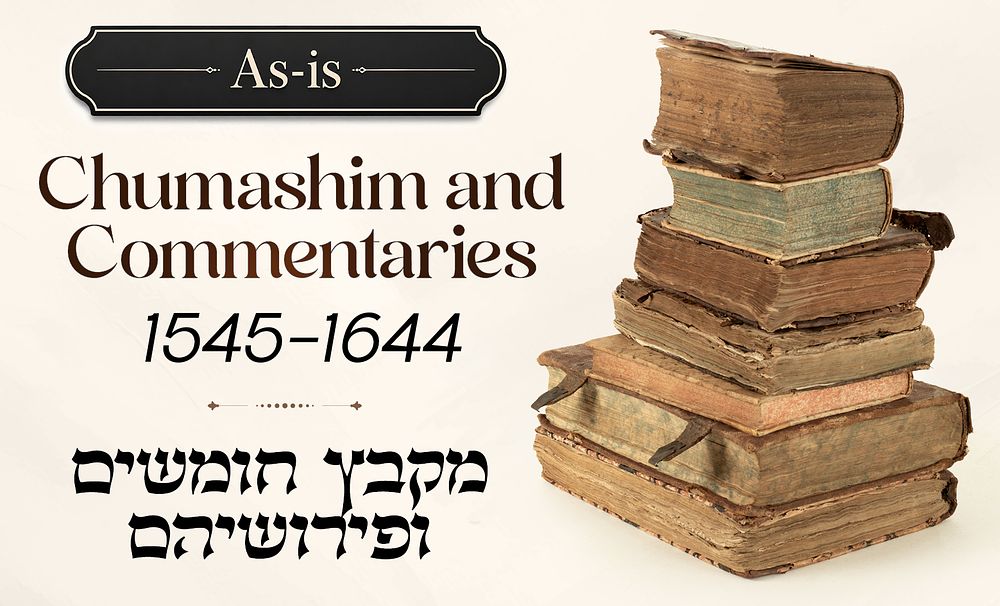
Bidspirit auction | Group of Important Incomplete Sefarim:
Group of Important Incomplete Sefarim: Chumashim, Torah Commentaries, and Midrashim – Italy and Salonika Printings, 1545–1644 * A substantial Group of eight Hebrew works, including Chumashim, commentaries and Midrashim on the Torah, printed during the sixteenth and seventeenth centuries, spanning exactly one hundred years. Most of the volumes are incomplete and in less-than-ideal condition, and have therefore been grouped together as a single lot. Chumashim: A. Five Chumashim with the haftaros, Mantua, [1589]–1590. Exceedingly rare edition . Incomplete copy. B. Five Chumashim with the haftaros, Venice, 1644. Incomplete copy. Torah Commentaries: C. Toldos Yitzchak, [Riva di Trento, 1558]. Incomplete copy. D. Rabbeinu Bachya on the Torah, [Riva di Trento, 1559]. Incomplete copy. E. To'aliyos HaRalbag, Riva di Trento, 1560. Copy with text loss. F. Abarbanel on the Torah, Venice, 1579. Sefer yesod, first edition. Complete copy, but damaged. Midrash and Glosses on Midrashim: G. Os Emes, Salonika, 1565. First edition. Complete copy. H. Midrash Rabbah on the Torah, [Venice, 1603], bound together with Midrash Rabbah on the Five Megillos from a different edition: Venice, 1545. Includes the original Giustiniani title page for the Five Megillos, which is exceptionally rare. See below for a detailed description of each work and its contents. Italy and Salonika printings, 1545–1644 . A total of 8 works in 8 volumes. Various sizes and conditions; see the detailed descriptions below. Please review the detailed description and photographs before placing a bid. Additional photographs are available upon request. - - - - - - - - - - - Detailed Description: A. Five Chumashim with Targum Onkelos and Rashi. At the end, there is a separate title page for the Five Megillos and the haftaros according to the customs of the Italian, Ashkenazi, and Sephardic communities. From the comments of the editor, Rabbi Meshulam Salem, it emerges that this was the first edition to print the haftaros according to the customs of all three communities. This is likewise stated on the separate title page for the haftaros, which is present in this copy. The final two leaves contain the editor's concluding remarks. These leaves are exceptionally rare and are absent from both copies in the National Library of Israel. Although they are mentioned by the Institute for Hebrew Bibliography, they are not included in its page count. Likewise, the seventh leaf at the beginning of the haftaros, containing the cantillation names “according to the Italian order, ” is not recorded by the Institute for Hebrew Bibliography. A thick and impressive volume in medium-small format (15.2 cm), containing more than 1,300 printed pages. Mantua, 1589–1590. Page Count: Chumash: 564 leaves; Megillos: [7], 80, 82–87, [2] leaves. A total of 3 leaves are missing: the title page of the Chumash, and leaves 81 and 88 of the Five Megillos. Height: 15.2 cm. Condition: Good-fair to fair. Stains. Repairs to the final leaves. Holes along the inner margins. A few erasures and handwritten additions. A thick volume with one surviving clasp (the second is lacking). Worn binding with numerous holes along the spine. B. Five Chumashim with Targum and the Five Megillos. At the end, with a partial title page for the haftaros “according to the custom of all Jewish communities.” The biblical text and the Targum are printed on facing pages. Venice, 1644. Page Count: 40, 42–72, 74–79, 81–96, 98–184, 186–191, 193–238, 240–304, 306–311, 313–344, 353–357, 359–368, 370–379, 382–447, 451–511, 514–537, [2] leaves. A total of 38 leaves are missing: 41, 73–80, 97, 185–192, 239, 305, 312, 345–352, 358, 369, 380–381, 448–450, 512–513. The Institute for Hebrew Bibliography records an additional leaf at the end. It is not recorded by the National Library of Israel and is not present here. C. Toldos Yitzchak, Rabbi Yitzchak Karo's Commentary on the Torah. One of the most widely studied Sephardic works of Torah exposition during the sixteenth century. The Chida lists it in Shem HaGedolim alongside the great Sephardic works of sifrei drush: “The delightful Akeidas Yitzchak, the illustrious sefer Toldos Yitzchak, and similar works.” The work was first printed in Constantinople in 1518. (It was printed and distributed in installments, making complete copies exceptionally rare.) The present copy is the second edition. Rabbi Yitzchak Karo (1488–1535) was one of the leading sages of Spain in the generation of the Expulsion and was a Rosh Yeshiva in Portugal. After the Expulsion from Portugal, he settled in Turkey, where he raised his nephew, Rabbi Yosef Karo, author of the Shulchan Aruch. Rabbi Yosef Karo absorbed much Torah from his uncle and repeatedly refers to him in the Beis Yosef (Orach Chaim 31, 382, 391) as “my teacher and uncle.” Riva di Trento, 1558. Page Count: 1–113 leaves. Incomplete copy.