Bidspirit auction | A collection of books from
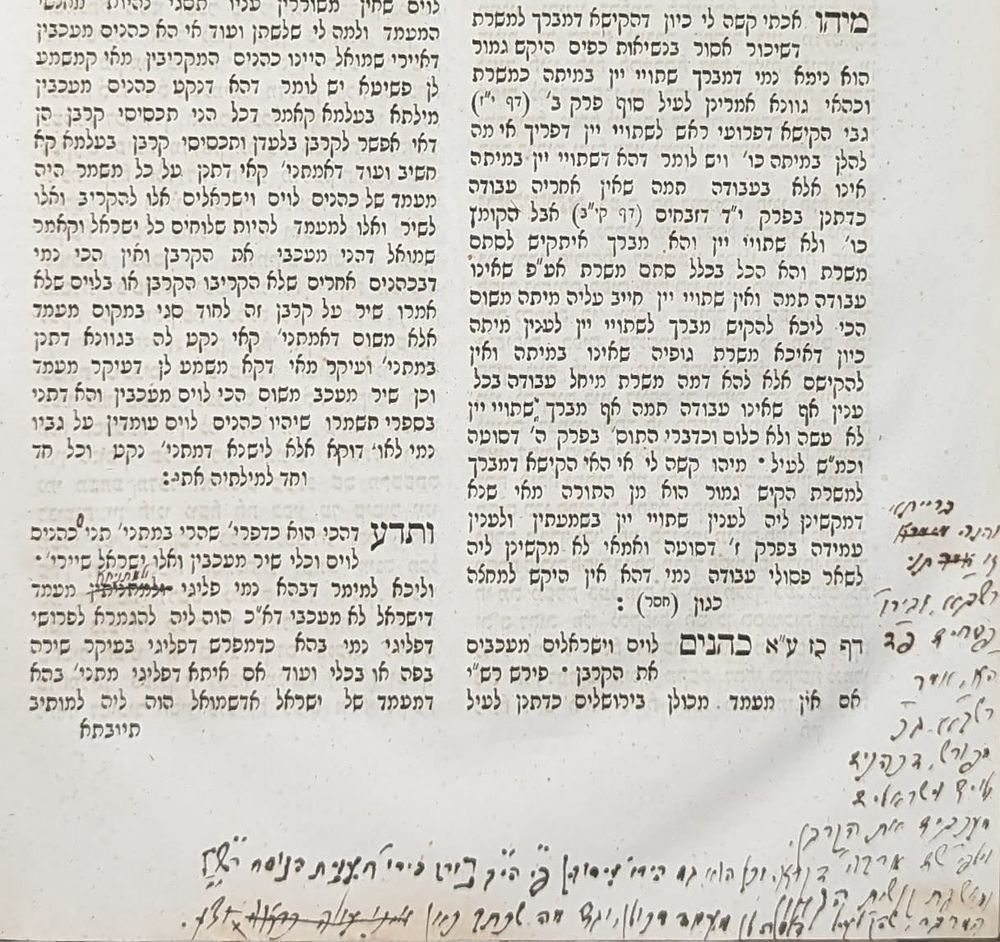
A collection of books from the library of the Gaon Rabbi Ephraim Samonov, a student of Rabbi Ham Brisker and Rabbi of Windoy - scholarly glosses in his own hand - attached is the booklet HaKohen HaGadol VeHasegan his book which was printed in Riga The gaon Rabbi Ephraim Samonov was one of the greatest students of Rabbi Chaim Soloveitchik, at the Volozhin yeshiva, who would prepare his lessons together with some virtuous individuals from the students of the yeshiva, among whom was Rabbi Ephraim. During his sabbatical at the Volozhin yeshiva during this period, he conducted correspondence with the yeshiva administration to the Ministry of Education in St. Petersburg, which demanded that secular studies be included in the yeshiva's curriculum. Rabbi Ephraim Samonov, who spoke well in Russian, together with Rabbi Haim Soloveitchik formulated the Yeshiva's position and the lobbying letters that the Yeshiva management tried to implement. 1. Sefer Gevurat Ari, on the tractate Ta'anit by the Noda Be'Yehuda, Rabbi Yehezkel Landa Rabbi of Prague. His stamp and signature on the cover of the book and a number of scholarly theoretical glosses between the pages of the book. 2. Sefer Kesef Nivhar, Lemberg edition, 1878. His stamp and signature on the cover of the book and a number of theoretical glosses. 3-6. Megillat Ta'anit, Warsaw, 1874. Shu”t HaRi”f Warsaw, 1884. Sefer Tashbatz, Warsaw, 1876. Takfo Cohen, Warsaw, 1884. Bound together. His hand signatures on the cover of each book. 7. HaKohen HaGadol VeHasegan - by Rabbi Ephraim Samonov - Riga, around 1930 His history The Gaon Rabbi Ephraim Samonov was born on the 5th of Sivan 1860 in Filtan. His father, Rabbi Gershon Menachem (Mendel) Samonov, son of Rabbi Mordechai Uri Samonov (who was rabbi of several cities in Courland). At the age of fifteen he went to study torah at the Volozhin Yeshiva where he studied for three years. He became known there as one of the elite students and was very close to Rabbi Chaim Soloveitchik, he was often praised for his good sense and deep understanding. Over time, he became a member of R Haim's household and his confidant. He was also very close to his father, Rabbi Yosef Dov Soloveitchik, the 'Beit Halevi' and used to write down his lectures, and the rabbi liked his summaries more than the summaries of the other students. He married Tama, the daughter of Rabbi Chaim Berlin, son of the Netziv of Volozhin, in 1883. his father-in-law Rabbi Chaim wrote about him: ”הבן יקיר לי אפרים לשעשועים בדברי תורה ומילי דעלמא”. After his wedding, he lived in Moscow, the city of his father-in-law's rabbinate, where he continued his studies and engaged in commerce. At the request of his father-in-law, he turned down an offer of rabbinate instead of his father in Windoy, and continued with his business. His uncle, Rabbi Eliyahu Aharon Mileykovsky, who lived in Volozhin at that time, said that during these years the Netziv from Volozhin reported to him several times with open joy about the deterioration of the business of Samonov, his granddaughter's husband. According to him, his talents and knowledge indicate him to be a great rabbi, but his money does not allow him to turn to it. Indeed, at one point Rabbi Ephraim Samonov lost all his money and returned to Volozhin to continue his studies for four years. He studied Shas and Poskim and stayed close to Rabbi Chaim Soloveitchik, who would prepare his lesson Together with individuals from the students of the Yeshiva, among whom was Rabbi Ephraim. During his sabbatical at the Volozhin yeshiva during this period, he conducted correspondence with the yeshiva administration in front of the Ministry of Education in St. Petersburg, which demanded that secular studies be included in the yeshiva's curriculum. Samonov, who spoke well in Russian, together with Rabbi Haim Soloveitchik drafted the yeshiva's position and the lobbying letters that the yeshiva management tried to implement. In 1890 he was elected to serve as rabbi of the city of Jacobstadt, Courland. In 1897, the chair of the rabbinate of his father and grandfather in the city of Windoy became vacant again, and he moved to serve in the rabbinate of this city. He carried the burden of the rabbinate for forty years. His name became famous in the world of Lithuanian yeshiva before the Second World War, and questions about Halacha were addressed to him from around the world. A compendium of his Torah innovations published by his son called ”The High Priest and the Deputy” caused a great stir in the world of learning. Despite his troubles in public affairs and the general, he was very persistent in his studies, and almost never stopped studying. His attempts to immigrate to Israel were unsuccessful, for various reasons. After he fell ill with his last illness, he made a last attempt and even managed to get a visa to immigrate, but it reached him about a month before his death, when his condition no longer allowed such a difficult journey.