Bidspirit auction | Extremely Rare: Original protection documents
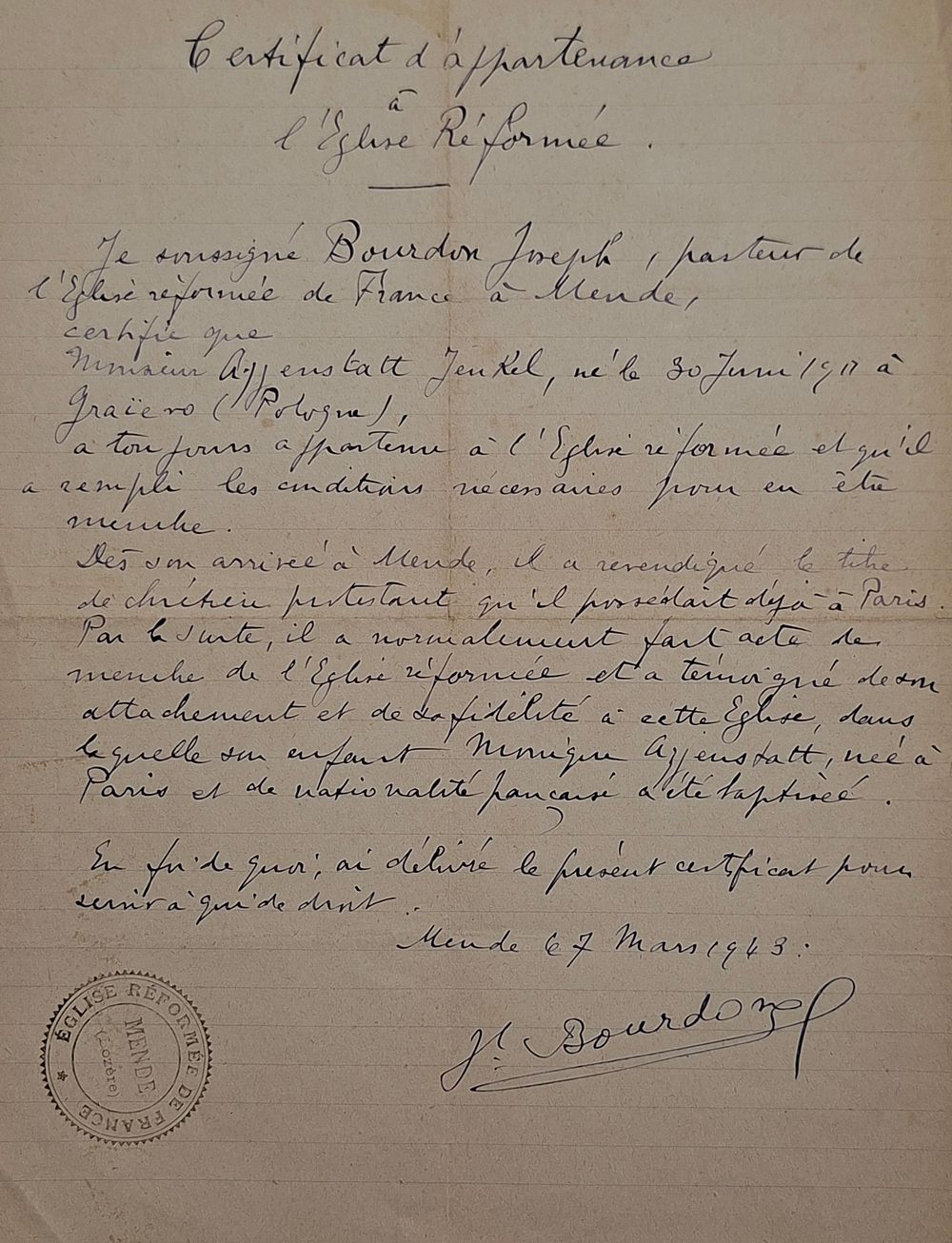
Extremely Rare: Original protection documents in the handwriting of Righteous Among the Nations Pastor Joseph Bourdon - unique physical evidence of underground rescue activity - The archive of Dr. Jankiel (Jacques) Ajzensztat (1913-1943). France, 1930s and 1940s. An archival collection comprising approximately 20 original documents, documenting the life, activity, and fate of medical student Jankiel Ajzensztat. The archive includes items of historical importance testifying to the operation of Protestant rescue mechanisms in the Lozere department under the Vichy regime. At the center of the collection: original documents in the handwriting and signature of Righteous Among the Nations Pastor Joseph Bourdon, who issued cover documents (baptism certificates and fictitious church confirmations) for the Jewish family in an attempt to prevent their deportation. The survival of these original forged documents, which were mostly destroyed at the end of the war for fear of incrimination, is extremely rare and constitutes a unique historical document and, to the best of our knowledge, is the only documentation of this heroic activity by Bourdon! Historical Background: Jankiel Lejba Ajzensztat (born in Grajewo, Poland, 1913) studied medicine at the University of Nancy in the 1930s. With the outbreak of the war, he moved to Paris, married dentist Wichna Kagan, and in 1940 fled with her and their infant daughter to southern France (the Free Zone). The family settled in the Lozere department. The documents in the collection reveal the daring mobilization of Pastor Joseph Bourdon (recognized by Yad Vashem in 1983, file no. 2698) on behalf of the family, and his attempt to save them in real time. The peak of this effort is reflected in a document dated March 7, 1943 - two weeks after Jankiel had already been arrested by the Gendarmerie (on Feb 20, 1943). In this document, the Pastor declared to the authorities that the detainee was a ”devout Protestant, ” in a desperate and final attempt to extract him from the claws of the Gestapo before being sent to the East. Despite the effort, Jankiel was transferred to the Drancy camp, and on March 6, 1943, was sent on Convoy 51 to the Majdanek extermination camp, where he perished. His wife and daughter survived. Item Details in the Collection: A. Protection and Rescue Documents - Pastor Bourdon: 1. Certificate of Baptism (Certificat de Bapteme): An official confirmation in Pastor Bourdon's handwriting and signature, testifying that the daughter Monique was baptized into Christianity in September 1940. This document was intended to grant the child a status before the authorities. 2. Certificate of Church Membership (Certificat d'appartenance): An official document signed by Pastor Bourdon, dated March 7, 1943. The document was written two weeks after Ajzensztat's arrest, and in it, the Pastor declares that the detainee is a ”Protestant known to him from Paris.” This document constitutes evidence of an intervention attempt and falsification of data for the purpose of releasing a detainee from the Gestapo. B. Documentation of the Arrest, Deportation, and Jankiel's Fate: 3. Eyewitness Testimony (3 handwritten pages, 1945): A letter addressed to the Purge Commission, written by Dr. Skowron (a physician, member of the French Resistance). The letter details the events of the day of the arrest (Feb 20, 1943), Ajzensztat's initial escape, his return to the hideout, and his surrender by the Gendarme Coulon. This document constitutes a chilling historical indictment, written in real time after the liberation for the ”Purge Commissions” (Epuration legale) that judged collaborators. The writer, Dr. Skowron, a member of the underground who knew the Ajzensztat family well, reconstructs ”minute by minute” the tragedy of February 20, 1943, in Saint-Chely-d'Apcher. The testimony reveals that Dr. Jankiel Ajzensztat was not caught by chance. With the start of the roundup (Rafle) in the town, Jankiel managed to slip away from his home and hide, thus escaping the first wave of arrests. However, his concern for the fate of his wife Wichna and his infant daughter Monique, who remained behind, overwhelmed him. Dr. Skowron describes how Jankiel made the fatal mistake and returned to the house to ensure they were safe - a decision stemming from love and responsibility, but which cost him his life. At this point, the figure of the French Gendarme Coulon enters the picture. The letter describes Coulon not merely as following orders, but as an obsessive pursuer who acted cruelly to capture the Jewish doctor. Skowron describes the arrest as a violent and brutal action, carried out in front of the family, and emphasizes the Gendarme's direct part in handing Jankiel over to the Germans. The letter ends with a demand for justice and punishment of the traitor, and serves as rare testimony to the dynamics of extradition and collaboration in the rural districts of France. 4.